Compliance & Legal

Last Updated: September 19, 2025

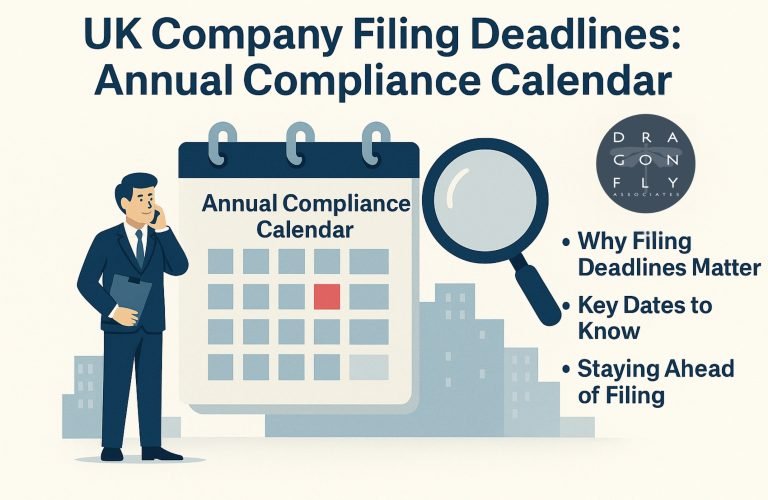
Keeping your UK company compliant isn’t just about staying in business—it’s about avoiding costly penalties and maintaining your company’s reputation. One of the most common mistakes made by directors is missing key deadlines.

This article outlines the most important UK company filing dates you need to know, and how Dragonfly Associates helps clients stay ahead—subject to agreement.

Why Filing Deadlines Matter

  • Financial penalties
  • Company strike-off warnings
  • Loss of good standing with Companies House or HMRC
  • Difficulty obtaining loans, investors, or credit

Dragonfly Associates tracks your deadlines, sends alerts, and handles filings under our annual compliance packages.

Key Filing Deadlines for UK Companies


Key Filing Deadlines for UK Companies

Here’s a breakdown of the most common filing obligations for private limited companies in the UK:

Filing Type Deadline (After Event) Notes
Confirmation Statement (CS01) 14 days after confirmation date Due annually, confirms company information
Annual Accounts (first year) 21 months after incorporation For new companies only
Annual Accounts (ongoing) 9 months after accounting year-end Applies from second year onward
Corporation Tax Return (CT600) 12 months after accounting year-end Filed with HMRC
Corporation Tax Payment 9 months + 1 day after accounting year-end Must be paid before CT600 is filed
PAYE / NI Payments (monthly) 22nd of each month (if paying electronically) For employers
VAT Returns (if registered) Usually quarterly – 1 month + 7 days after VAT period Depends on VAT scheme used
Companies House Event Changes Within 14 days of change (e.g. director, address) File appropriate form (e.g. CH01, AD01)


How to Stay Compliant All Year Round

  • Use accounting software with compliance reminders
  • Work with a provider that monitors dates on your behalf
  • Store your authentication code securely for quick online filing
  • Review your company register regularly

Dragonfly Associates offers full annual compliance monitoring, filings, and documentation maintenance to eligible clients—subject to agreement.

Penalties for Late Filing

  • Companies House penalties (starting at £150 and rising to £1,500+)
  • Strike-off procedures for missed filings or unpaid penalties
  • HMRC interest charges or late payment fines
  • Director disqualification in severe cases

We help prevent this through deadline tracking and proactive filing.

Frequently Asked Questions

Can I change my year-end?

Yes. You can apply to shorten or extend your accounting period with Companies House. We can assist with the application.

What if I miss a deadline?

Contact us immediately. We may be able to help file quickly and mitigate penalties or objections, depending on the situation.

Can Dragonfly Associates manage all filings for me?

Yes. We provide comprehensive annual filing support, including accounts, Confirmation Statements, tax returns, and more—subject to agreement.

Never Miss a Deadline Again

Running a company involves more than great ideas—it requires staying compliant with UK filing obligations. By knowing your key dates and working with the right partners, you can stay ahead and avoid unnecessary risk.

Dragonfly Associates tracks your filing calendar, handles all required submissions, and provides ongoing advice through our compliance and accounting service plans.

To simplify your company’s compliance and never miss a deadline again, contact us today.

Last Updated: September 19, 2025
In the UK, most company filings are now done online through Companies House WebFiling. To access your company’s records, make updates, or submit forms, you need one critical piece of information: your company authentication code.This article explains what the Companies House authentication code is, why it’s important, and how Dragonfly Associates helps clients manage their codes securely—subject to agreement.

What Is the Authentication Code?

The authentication code is a 6-character alphanumeric password assigned to your company by Companies House.

It acts as your digital signature and verifies that the person making online filings (e.g. changes to directors, registered office, share capital) is authorised to do so.

Think of it as your company’s filing password.

When Do You Need the Code?

You’ll need your authentication code to:

  • File Confirmation Statements (CS01)
  • Update director or shareholder details
  • Change the company’s registered office
  • File annual accounts or make corrections
  • Submit share allotments (SH01), changes (SH02), or capital statements
  • Authorise third-party providers or software

Dragonfly Associates uses the authentication code to file statutory documents on behalf of clients, where agreed.

How Do You Get It?

You’ll receive the authentication code when you:

  • Form your company using Companies House directly
  • Form your company through a registered agent (the agent may receive the code first)

It is posted to your registered office address for security purposes.

We ensure our clients receive their code securely, and we store it safely as part of our ongoing compliance services.


Lost or Forgotten Your Authentication Code?

Lost or Forgotten Your Code?

If you’ve lost your code or didn’t receive it:

  1. Go to the Companies House WebFiling service
  2. Request a new authentication code
  3. It will be posted to your registered office within 5 working days

Dragonfly Associates helps clients retrieve and reset authentication codes, especially when acting as the registered office or managing filings.

Protecting Your Authentication Code

Treat your authentication code like a company password. If it falls into the wrong hands, someone could make unauthorised changes to your public company record.

Tips for protection:

  • Never share it publicly or include it in unsecured emails
  • Only give access to trusted professionals
  • Keep it separate from general company documents
  • Update it if you suspect misuse

We follow strict confidentiality protocols when storing and using client authentication codes, depending on your service package.

Frequently Asked Questions

Can I change my authentication code?

Yes. You can log into WebFiling and choose a new code if you’re already authenticated.

Can I file documents without the code?

Only certain paper filings are allowed without it. Most online submissions require the code.

Can Dragonfly Associates use the code on my behalf?

Yes. With your consent, we use your authentication code to submit filings and maintain your company’s records under agreement.

Stay in Control of Your Company’s Filings

Your authentication code is essential to managing your company’s online presence with Companies House. Losing it—or letting it fall into the wrong hands—can cause delays or risks.

Dragonfly Associates helps you secure, recover, and use your code safely, while managing your filings on time and in full compliance.

Need help locating or protecting your authentication code? Contact our team today.

Last Updated: September 19, 2025
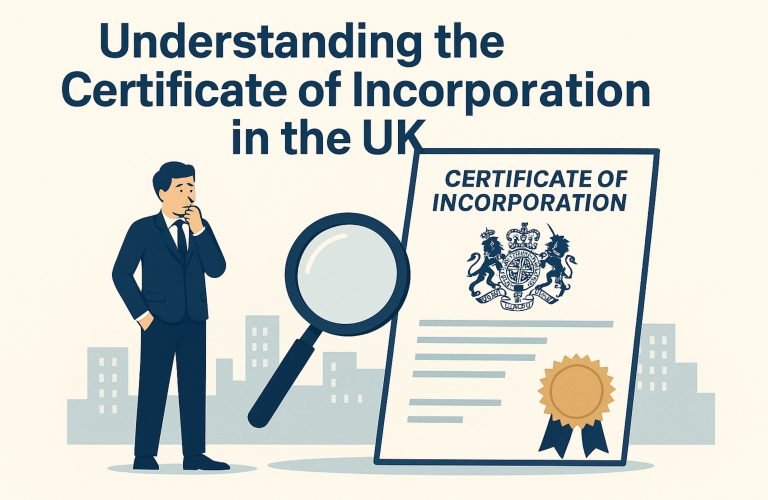
If you’ve recently registered a company in the UK, one of the most important documents you’ll receive is the Certificate of Incorporation. But what exactly is it—and why does it matter?This guide explains what the Certificate of Incorporation is, what information it includes, why it’s important for legal and financial purposes, and how Dragonfly Associates can support your business—subject to agreement.

What Is a Certificate of Incorporation?

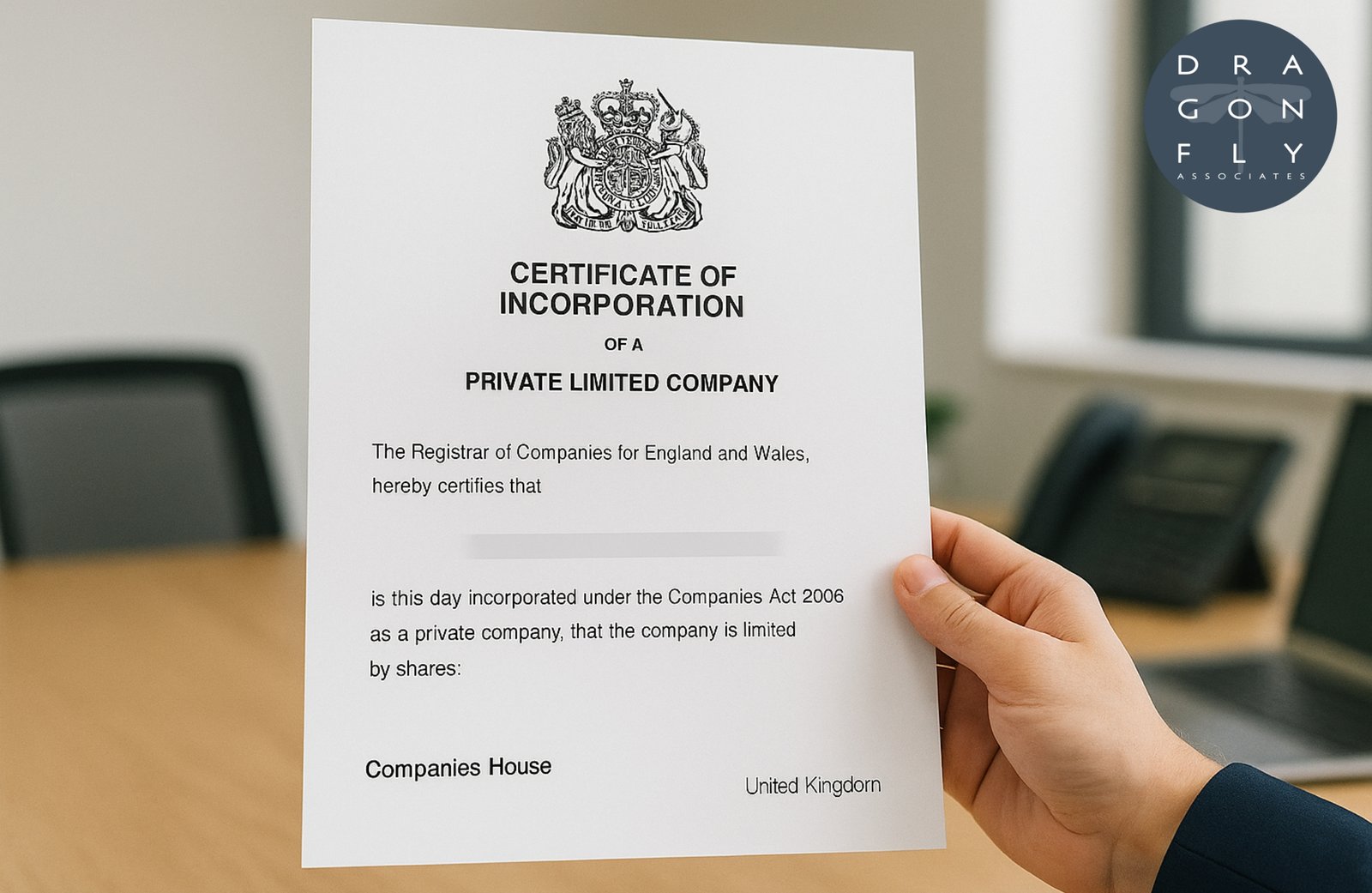
The Certificate of Incorporation is an official document issued by Companies House upon successful registration of a company in the UK. It acts as your company’s “birth certificate.”

It confirms that:

  • The company has been legally formed under the Companies Act 2006
  • The business exists as a separate legal entity
  • The company name, number, and date of incorporation are officially recognised

What Information Does It Include?

Your certificate will include several key details, such as:

  • Company name
  • Company number (CRN)
  • Date of incorporation
  • Jurisdiction (e.g., England & Wales, Scotland, or Northern Ireland)
  • Companies House registrar’s authentication


Why Is the Certificate of Incorporation Important?

Why Is It Important?

The Certificate of Incorporation is essential for proving your company’s existence. It’s often needed to:

  • Open a business bank account
  • Apply for funding or grants
  • Sign leases or contracts
  • Register for VAT or PAYE
  • Provide assurance to clients and suppliers

Digital and Paper Versions

Companies House issues digital certificates for online incorporations, but you can also request a printed version. Both are equally valid legally.

Lost Your Certificate?

If you’ve lost your certificate, don’t worry. You can:

  • Download a copy from Companies House (if registered online)
  • Request a replacement via post
  • Ask your formation agent for assistance (if you used one)

Dragonfly Associates can assist you with retrieving official documents and ongoing compliance matters—subject to agreement.

How Dragonfly Associates Can Help

We provide support for:

  • Company formation
  • Compliance filing
  • Certificate retrieval and documentation
  • Registered office and service address provision

Whether you’re a UK-based entrepreneur or an overseas director, we ensure all your company documents are in order and accessible when you need them.

Frequently Asked Questions

Is the Certificate of Incorporation proof of ownership?

No. It proves formation, not ownership. Shareholder records provide ownership information.

Do I need the certificate to trade?

While you can trade without showing it, many third parties (banks, landlords, etc.) require it as proof your company exists.

Does it expire?

No. The certificate is valid indefinitely unless the company is dissolved.

Final Thoughts

The Certificate of Incorporation is a critical document in your business journey. Keep it safe and accessible. If you ever need help managing or replacing your certificate—or ensuring your company stays compliant—Dragonfly Associates is here to assist, subject to agreement.

Last Updated: September 19, 2025
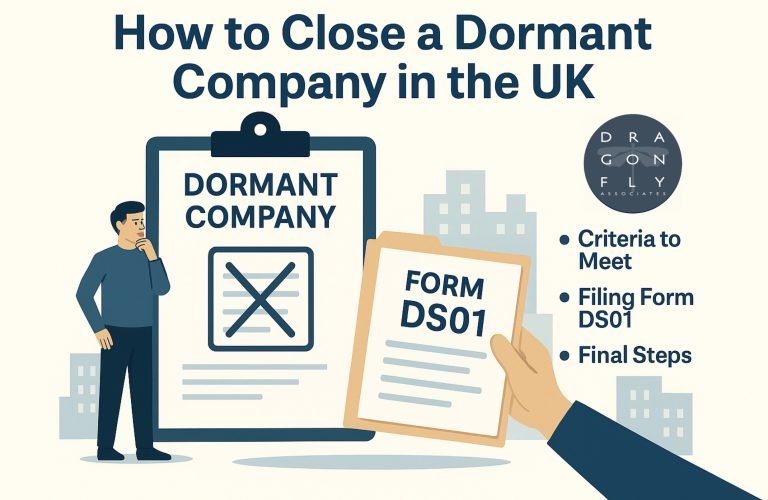
Even if your company is dormant (inactive and not trading), you can’t simply ignore it. If you no longer need your UK dormant company, it’s important to formally close it to avoid ongoing filing obligations or penalties.This guide explains how to close a dormant company properly, what steps are required, and how Dragonfly Associates helps clients complete the process—subject to agreement.

What Is a Dormant Company?

A dormant company is one that has no “significant accounting transactions” and is not actively trading. You may have kept the company dormant for brand protection, investment planning, or future use.

However, maintaining a dormant company still requires:

  • Annual accounts (simplified)
  • Confirmation Statements
  • Maintenance of statutory registers

If you no longer need it, dissolving the company can save time and cost.

How to Close a Dormant Company

Dormant companies are usually closed through a voluntary strike-off using form DS01. The process is straightforward if:

  • The company has not traded or changed names in the last 3 months
  • There are no outstanding debts, liabilities, or legal actions
  • Assets (if any) have been dealt with properly

Dragonfly Associates reviews your company’s eligibility for strike-off and prepares the necessary documentation.


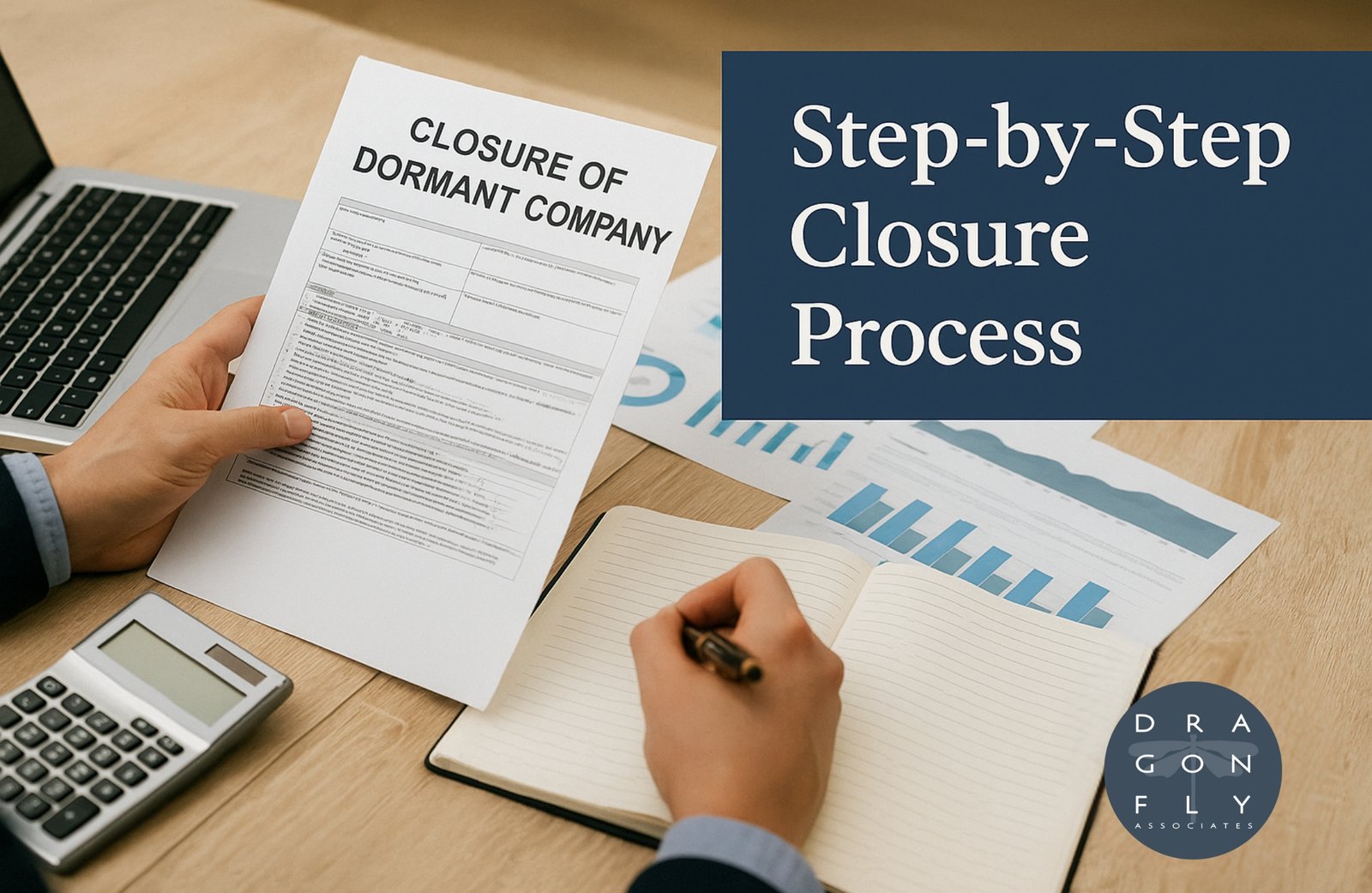
Step-by-Step Closure Process

Step-by-Step Closure Process

1. Board Approval

Pass a resolution confirming that the company is no longer needed and will apply for strike-off.

2. Prepare and Submit DS01

Form DS01 must be signed by a majority of directors and submitted to Companies House along with the appropriate fee (£10).

Once accepted, Companies House will publish a notice in The Gazette stating the intention to strike the company off.

3. Wait for Objections

If no objections are received within 2 months, the company will be formally dissolved and removed from the register.

We monitor this timeline and manage all communication with Companies House.

Settling Any Remaining Obligations

Before submitting DS01, make sure:

  • Final dormant accounts are filed (if required)
  • Confirmation Statement is up to date
  • HMRC is informed of your intent to dissolve
  • Business bank accounts are closed
  • Any remaining company assets are distributed

Failing to do so may lead to rejection of the application or future complications. We help ensure all loose ends are tied up.

Avoiding Future Costs or Penalties

Leaving a dormant company open can lead to:

  • Automatic penalties for missed filings
  • Strike-off by Companies House without warning
  • Potential director disqualification for repeated non-compliance

We help you close your dormant company cleanly and without risk.

Frequently Asked Questions

Do I have to file accounts before closing a dormant company?

Yes, you must file any due accounts and make sure the company is fully compliant before applying for strike-off.

Can I reopen a company after it’s closed?

No. Once dissolved, the company no longer exists. Restoration is possible, but it requires a formal application and justification.

Can Dragonfly Associates help with this?

Yes. We assist with DS01 preparation, compliance checks, and all closure filings under defined support packages—subject to agreement.

Close Your Dormant Company the Right Way

Closing a dormant company is simple—but only if the process is handled correctly. With proper filings and communication, you can dissolve your company and move forward without risk.

Dragonfly Associates provides full support for dormant company closure, including final checks, filings, and liaison with Companies House—delivered under service agreement.

Contact our team today to begin your company’s closure with confidence.

Last Updated: September 19, 2025
When setting up or managing a UK limited company, many directors wonder whether appointing a company secretary is mandatory—or even useful. While not always legally required, the role can be highly beneficial for compliance, governance, and efficiency.In this article, we explain whether your UK company needs a company secretary and how Dragonfly Associates provides secretarial support, subject to agreement.

Is a Company Secretary Legally Required?

In most cases, no. For private limited companies in the UK:

  • A company secretary is not legally required
  • The company’s directors can handle secretarial duties themselves

However, for public limited companies (PLCs), appointing a qualified company secretary is a legal requirement.

We advise private companies on whether appointing one is beneficial for their structure.

What Does a Company Secretary Do?

What Does a Company Secretary Do?

Even when optional, a company secretary can play a key role in corporate governance and compliance. Typical responsibilities include:

  • Maintaining statutory registers
  • Filing accounts and Confirmation Statements
  • Preparing board minutes and resolutions
  • Ensuring Companies House filings are made on time
  • Liaising with shareholders and regulators
  • Supporting board meetings and decisions
  • Handling share transfers and capital changes

Dragonfly Associates performs these functions for clients through our Company Secretarial Services—subject to service agreement.

Why Appoint a Company Secretary?

You may choose to appoint a secretary if:

  • You want to delegate compliance tasks
  • You have multiple shareholders or directors
  • You want stronger internal controls and documentation
  • You plan to attract investment or undergo due diligence
  • You want professional oversight without hiring in-house staff

Appointing a secretary gives you more structure—especially as your business grows.

How to Appoint a Company Secretary

To appoint a secretary:

  1. Pass a board resolution (if not already authorised in the Articles)
  2. File form AP03 with Companies House (for an individual) or AP04 (for a corporate entity)
  3. Update your company’s internal records and statutory registers

We prepare resolutions and file forms for clients enrolled in our secretarial or governance packages.

Can a Director Be the Company Secretary?

Yes, a director can also act as company secretary in a private limited company. However, in PLCs, the secretary must be qualified and independent from certain roles.

We help determine the best structure based on your company type and goals.

Frequently Asked Questions

Can I remove a company secretary later?

Yes. You can file form TM02 with Companies House and update your records. We assist with this process.

Will not having a secretary affect my compliance?

Not necessarily—but someone must perform those duties. Many directors find it easier to delegate these responsibilities.

Does Dragonfly Associates act as company secretary?

Yes. We offer named company secretary services and support clients with filings, register maintenance, and board documentation—subject to agreement.

Stay Compliant Without the Stress

You don’t need a company secretary to run a compliant company—but having one can help ensure your business runs smoothly, especially as it grows or seeks investment.

Dragonfly Associates provides tailored company secretarial services, including register updates, filings, and resolution drafting—offered as part of clearly defined compliance packages.

To discuss your company’s governance needs, contact our team.

Last Updated: September 19, 2025
When you’re listed as a director of a UK company, your details—including your address—become part of the public record. Fortunately, the law allows directors to use a service address to protect their personal privacy.In this article, we explain what a service address is, how it differs from a residential address, and how Dragonfly Associates supports directors with secure address services—subject to agreement.

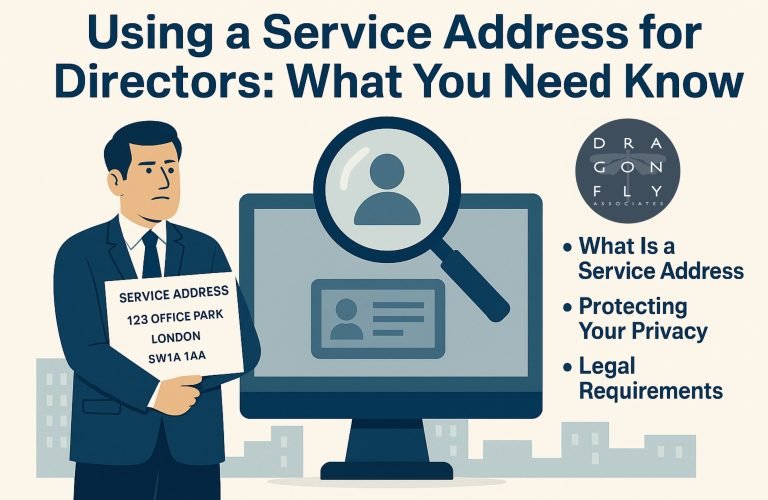
What Is a Director’s Service Address?

A service address is the official correspondence address for a company director, used by Companies House and made publicly visible.

Key characteristics:

  • It must be a real UK address (not a PO Box)
  • It may be the same as the registered office or a separate address
  • It is where statutory correspondence is sent
  • It is published on the public register

It can be different from the director’s residential address, which remains private if a valid service address is provided.

Why Use a Service Address?

Using a service address allows directors to:

  • Protect their home address from public view
  • Maintain privacy from clients, suppliers, or the general public
  • Avoid unwanted mail or identity risk
  • Present a more professional image

Dragonfly Associates offers secure service address options with mail handling and scanning included where applicable.

Service Address Legal Requirements

Legal Requirements

To be valid, a service address must:

  • Be located in the UK (or in the same jurisdiction as the company)
  • Be capable of receiving official mail
  • Not be a PO Box without a physical location
  • Be accessible for document delivery by Companies House or HMRC

Failure to maintain a valid service address may lead to Companies House publishing the director’s residential address by default.

We help directors ensure their address meets all legal requirements.

How to Set or Change a Service Address

To update a director’s service address:

  1. File form CH01 with Companies House
  2. Ensure the new address is valid and active
  3. Update the company’s internal records and statutory registers

Dragonfly Associates submits CH01 forms and provides address management for directors under our compliance and privacy packages.

Service Address vs Residential Address

Feature Service Address Residential Address
Appears on public record? Yes No (if service address is valid)
Used for legal mail? Yes No (unless service address is invalid)
Can it be a commercial provider? Yes No (must be the director’s real home)
Is it legally required? Yes Yes (but kept private by default)

Frequently Asked Questions

Can I use the company’s registered office as my service address?

Yes, as long as it meets the service address criteria. Many directors do this for simplicity.

Do I still need to provide my residential address?

Yes, but it will be kept private unless your service address becomes invalid.

Can Dragonfly Associates act as my service address?

Yes. We offer secure service addresses for directors and PSCs, with optional mail scanning and forwarding—subject to agreement.

Protect Your Privacy Without Compromising Compliance

Your public-facing director address doesn’t have to be your home. A service address offers a practical and legal way to maintain privacy while remaining compliant.

Dragonfly Associates provides director service addresses, CH01 filings, and secure mail handling through our registered office and privacy services—available under defined service plans.

To set up or update your director’s service address today, contact our team.

Last Updated: September 19, 2025
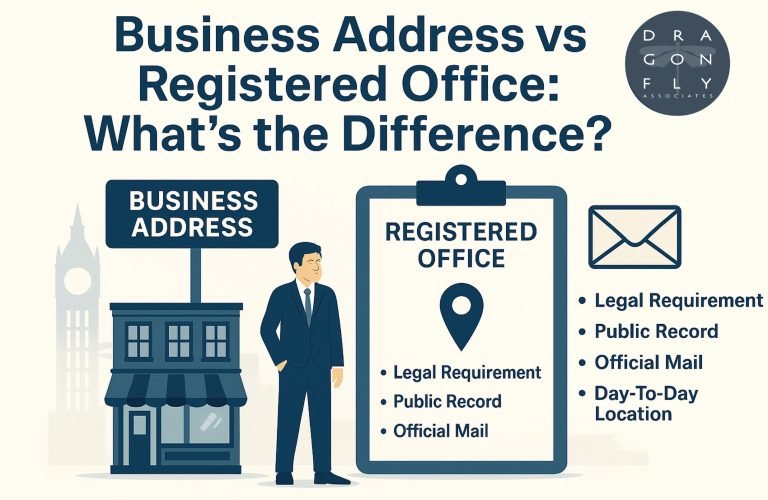
When forming or managing a UK limited company, it’s important to understand the difference between your registered office and business address. While both may involve mail and company records, they serve different legal and operational purposes.In this article, we explain how each address is used, what’s required by law, and how Dragonfly Associates supports clients with secure address services—subject to agreement.

What Is a Registered Office?

A registered office is your company’s official legal address, used by Companies House and HMRC for formal correspondence.

Key points:

  • It must be a real UK postal address (not a PO Box)
  • It must be in the same country where the company is incorporated (England & Wales, Scotland, or Northern Ireland)
  • It is publicly visible on the Companies House register
  • It is where statutory mail (e.g. notices, legal documents) is delivered

Dragonfly Associates offers registered office services for clients who prefer not to use their personal or trading address.

What Is a Business Address?

What Is a Business Address?

A business address is where your company conducts its day-to-day operations. It may be:

  • A physical office or retail location
  • A shared workspace or virtual office
  • The address you use on marketing materials, invoices, or email signatures

It is not a legal requirement to have a separate business address. However, having one helps present a professional image and keep your registered office private.
We provide business address services to clients needing a dedicated UK presence.

Key Differences at a Glance

Feature Registered Office Business Address
Legally required? Yes No
Public on Companies House? Yes No (unless used elsewhere)
Mail received? Official government mail Client or general mail
Can be a residential home? Yes (but not recommended) Yes (but may affect privacy)
Used for trading activity? No Yes

Why Keep Them Separate?

Separating your registered office and business address can help you:

  • Protect your personal address from being listed online
  • Create a more professional or London-based image
  • Receive different types of mail at different locations
  • Delegate statutory mail handling to a trusted provider

Dragonfly Associates can act as both your registered office and business address provider, subject to agreement.

Changing Your Registered Office or Business Address

To update your registered office:

  • File form AD01 with Companies House
  • Ensure the new address meets legal requirements
  • Notify HMRC and relevant stakeholders

To update your business address:

  • Simply begin using the new address on invoices, website, and communications
  • Inform clients, suppliers, and partners
  • No Companies House filing is needed

We handle registered office updates and offer mail scanning or forwarding services for both address types.

Frequently Asked Questions

Can I use one address for both purposes?

Yes, provided it meets the legal criteria for a registered office. However, many companies choose to separate them for privacy and operational reasons.

Do I need to use a UK address provider?

If you’re based outside the UK or want a professional address, using a provider like Dragonfly Associates ensures your mail is handled promptly and securely.

Can I change my addresses later?

Yes. Registered office changes must be filed with Companies House. Business addresses can be changed without any formal filings.

Use the Right Address for the Right Purpose

Your registered office and business address serve different functions—legal vs operational. Understanding the distinction helps protect your privacy, improve professionalism, and ensure compliance.

Dragonfly Associates provides registered office and business address services with optional mail forwarding, scanning, and compliance support—offered under clearly defined packages.

To set up or change your company address today, contact our team.

Last Updated: September 19, 2025
If your UK limited company has been dissolved—whether voluntarily or by action of Companies House—it may be possible to restore it to the register. Restoring a company allows you to continue trading, recover assets, or correct an administrative error.In this article, we explain when and how you can restore a dissolved company in the UK and how Dragonfly Associates supports clients through the process, subject to agreement.

What Does “Dissolved” Mean?

A dissolved company has been officially removed from the Companies House register. It is no longer a legal entity and cannot:

  • Trade or operate
  • Own property or bank accounts
  • Enter into contracts or be sued

All remaining assets at the time of dissolution become “bona vacantia”—the property of the Crown.
If the company was struck off in error or you need access to assets, restoration may be necessary.

Methods of Company Restoration

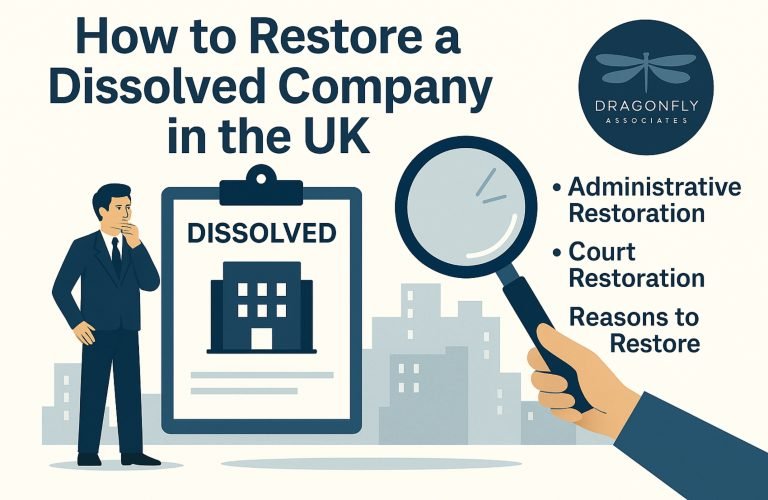
There are two main ways to restore a UK company:

  1. Administrative Restoration
  2. Court Restoration

Each method has different requirements and is used in different circumstances.

1. Administrative Restoration

Available if:

  • The company was struck off by Companies House (not voluntarily)
  • The application is made within 6 years of dissolution
  • The company was in compliance at the time of dissolution (or can bring filings up to date)
  • You were a director or shareholder at the time of dissolution

You must:

  • Submit form RT01
  • Provide a court fee and restoration fee
  • File all outstanding accounts and Confirmation Statements
  • Pay any penalties or late filing fees

Dragonfly Associates assists with form preparation, late filings, and correspondence with Companies House and HMRC as part of our restoration support service.

2. Court Restoration

Required if:

  • The company was dissolved voluntarily
  • You are not a former director or shareholder
  • More than 6 years have passed
  • You need to recover an asset or resolve a claim

This involves:

  • Filing a claim with the court
  • Providing evidence and legal reasoning
  • Serving notice on the Treasury Solicitor (if assets are involved)
  • Attending a court hearing

We can help coordinate with legal professionals for complex restorations and provide background support throughout the process.

Reasons to Restore a Dissolved Company

Reasons to Restore a Company

  • To recover assets or funds still held in the company name
  • To re-commence trading under a previous brand
  • To correct an error or wrongful strike-off
  • To respond to legal or financial obligations arising after dissolution

Our team helps assess whether restoration is viable and worthwhile based on your goals.

Consequences of Restoration

Once restored:

  • The company is deemed to have continued in existence as if it were never dissolved
  • All obligations resume, including annual accounts, tax filings, and statutory registers
  • Any legal claims against or by the company may be revived

We help bring your company’s records up to date and re-establish compliance post-restoration.

Frequently Asked Questions

How long does restoration take?

Administrative restoration usually takes 2–3 months. Court restoration may take longer due to legal proceedings.

Can I restore a company just to access its bank account?

Yes, if the account was still open at dissolution. The funds become Crown property unless the company is restored.

Do I need to repay unpaid penalties?

Yes. All outstanding accounts, fees, and penalties must be resolved as part of the restoration process.

Bring Your Company Back the Right Way

Restoring a dissolved company is a legal and administrative process—but it’s often worth the effort if valuable assets, contracts, or branding are involved.

Dragonfly Associates provides tailored support for administrative restoration, including form preparation, Companies House filings, and catch-up compliance—offered under agreed service packages.

If your company was dissolved and you need help bringing it back, contact our team today.

Last Updated: September 19, 2025
If you’ve been appointed as a director of a UK limited company, you’re not just a figurehead—you have legal obligations under the Companies Act 2006. Understanding these duties is critical to avoiding liability, protecting your company, and maintaining public trust.In this article, we outline the main responsibilities of UK company directors and how Dragonfly Associates helps clients stay informed and compliant, subject to agreement.

What Is a Director?

A company director is someone appointed to manage a company on behalf of its shareholders. You don’t have to be a shareholder yourself—but once appointed, your decisions and actions must serve the company’s interests and comply with the law.

Directors can be:

  • Executive (involved in daily operations)
  • Non-executive (strategic oversight)
  • Sole (if you’re the only director and shareholder)

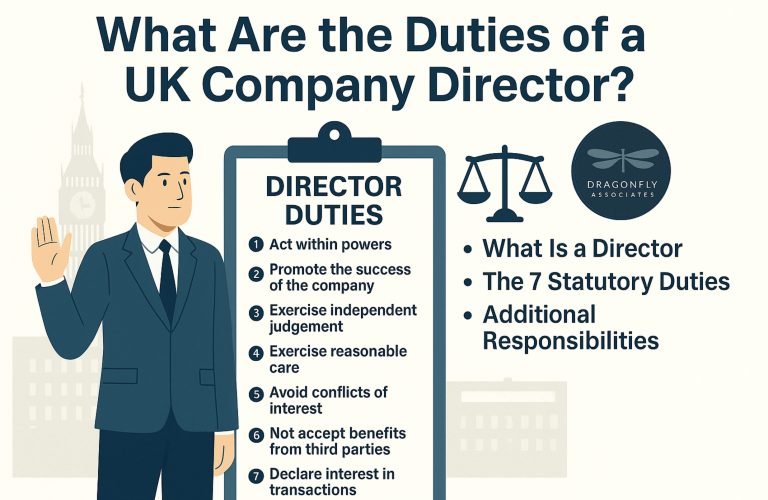
The 7 Statutory Duties of Directors

Under the Companies Act 2006, directors must observe the following seven duties:

  1. Act within their powers
    Follow the rules set out in the company’s Articles of Association.
  2. Promote the success of the company
    Make decisions that benefit the company’s long-term success and take into account employees, shareholders, customers, and the community.
  3. Exercise independent judgment
    Use your own reasoning and judgment, even when seeking outside advice.
  4. Exercise reasonable care, skill, and diligence
    Meet the standards expected of a competent person with your role and knowledge.
  5. Avoid conflicts of interest
    Disclose and manage any personal or financial interests that could influence your decisions.
  6. Not accept benefits from third parties
    Avoid gifts or rewards that may be seen as a conflict of interest.
  7. Declare interest in proposed transactions or arrangements
    Disclose to the board any interest you have in a transaction the company is considering.

Dragonfly Associates helps new directors understand these duties during onboarding and offers ongoing guidance under service agreement.

Directors' Additional Legal Responsibilities

Additional Legal Responsibilities

Directors are also responsible for:

  • Filing annual accounts and Confirmation Statements
  • Maintaining accurate company records (registers, minutes, etc.)
  • Ensuring the company pays the correct taxes on time
  • Operating payroll and deducting PAYE/NI correctly (if applicable)
  • Ensuring the company complies with GDPR and health & safety laws (where relevant)

We support compliance through managed filings, tax coordination, and registered office services depending on your selected plan.

Personal Liability and Risk

While a limited company offers legal protection, directors may still be held personally liable in cases of:

  • Fraud or deliberate misconduct
  • Wrongful or fraudulent trading
  • Breach of duties or fiduciary responsibilities
  • Failing to act in the best interest of the company

Having the right procedures and documentation in place is essential. We help directors avoid common pitfalls with proactive support.

Can a Director Be Removed?

Yes. A director may be removed by:

  • Resignation
  • Shareholder resolution under the Companies Act
  • Breach of contract or performance concerns (subject to agreements)

Dragonfly Associates helps companies follow the correct procedure for appointment or removal of directors, including documentation and Companies House filings.

Frequently Asked Questions

Can I be a director of more than one company?

Yes. There’s no legal limit, but you must manage each company’s obligations separately.

Can a non-UK resident be a director?

Yes. UK companies can have non-UK resident directors, as long as at least one human director is appointed.

Do I need to be a shareholder to be a director?

No. Directors and shareholders are legally distinct roles, though one person can hold both.

Lead Your Company Responsibly

Being a company director is both a privilege and a legal responsibility. By understanding your duties and seeking professional support, you can lead confidently and avoid costly errors.

Dragonfly Associates guides directors at every stage—from formation and appointments to annual filings and ongoing compliance—available under defined service agreements.

To ensure you’re fulfilling your obligations as a UK company director, contact us today.

© All rights reserved. Made with love by Ottmann-Polignac

4tehrwq

Congratulations! This company name is available.

4tehrwq

Unfortunately, this name is not available for registration.
Please select another.