Company Management

Last Updated: September 19, 2025
Company directors play a vital role in managing a UK limited company, but changes to the board are common—especially during growth, restructuring, or in response to shareholder decisions.In this article, we explain how to legally appoint or remove a director in a UK company and how Dragonfly Associates supports you through documentation and filing, subject to agreement.

Who Can Be a Director?

  • At least 16 years old
  • A natural person (not a corporate body, unless alongside human directors)
  • Not disqualified from acting as a director under UK law
  • Of sound mind and legal standing

There’s no UK residency requirement. Many international clients serve as directors of UK companies from abroad.

Appointing a New Director

Step 1: Check the Company’s Articles of Association

Before appointing a director, review the Articles of Association and any shareholder agreements. These documents may outline:

  • Who has authority to appoint
  • Any restrictions or voting thresholds
  • Rights of existing directors or shareholders

We help clients review these documents before proceeding.

Step 2: Obtain Necessary Approval

  • For most private companies, the board of directors can approve the appointment by majority resolution.
  • In some cases, shareholder approval may also be required.

Dragonfly Associates prepares board minutes and resolutions as part of our company secretarial services, where applicable.

Step 3: Notify Companies House

You must notify Companies House within 14 days by filing form AP01 (for an individual) or AP02 (for a corporate director).
Details required include:

  • Full name
  • Date of birth
  • Nationality
  • Occupation
  • Service address (can be a professional service address)

We handle the AP01/AP02 filing on behalf of clients using our director support packages.

Removing a Director

How to Remove a Company Director

A director can leave the board voluntarily—or be removed by shareholders or fellow directors in accordance with the law and company rules.

Step 1: Review the Articles and Agreements

Check if:

  • The director has a fixed term
  • Special procedures apply for removal
  • There are rights to notice, compensation, or appeal

We help assess legal risks before action is taken.

Step 2: Resignation or Shareholder Resolution

A director can resign by submitting a signed letter. The board should record this via a board resolution and file the change at Companies House.

If shareholders seek to remove a director (without resignation), they must:

  • Give special notice
  • Hold a general meeting
  • Pass an ordinary resolution with majority support

This process must be documented carefully. We can support drafting and guidance where agreed.

Step 3: File Form TM01

Form TM01 must be submitted to Companies House within 14 days of the director ceasing their role. We take care of this form and register update where included in your compliance plan.

What Happens After a Change?

  • Update the statutory register of directors
  • Notify relevant stakeholders, banks, and accountants
  • Ensure any director service address is updated or removed
  • Adjust internal access rights and contracts

We help maintain the company register and handle post-removal updates for clients under our secretarial services.

Frequently Asked Questions

Can I be the only director of my company?

Yes, a private limited company can operate with one director who is also the sole shareholder.

Do I need to notify Companies House?

Yes. Appointments and terminations must be reported within 14 days using the correct forms (AP01, TM01).

Can a director be removed without their consent?

Yes, under the Companies Act 2006, shareholders may remove a director by ordinary resolution—provided proper procedure is followed.

Make Director Changes with Clarity

Appointing or removing a director is a normal part of business—but it must be handled correctly to avoid legal or operational complications.

Dragonfly Associates provides full support for director appointments, resignations, and removals, including legal review, resolution drafting, and Companies House filings—delivered under agreed service plans.

To manage your board effectively and stay compliant, contact us today.
Last Updated: September 19, 2025
Whether you’re repositioning your brand, bringing on new partners, or simply outgrowing your original name, changing your company’s name is a strategic move that must be done properly.This article explains how to legally change your company name in the UK, what branding factors to consider, and how Dragonfly Associates supports you throughout the process—subject to agreement.

Why Change a Company Name?

  • Rebranding or repositioning the business
  • Reflecting new ownership or partnerships
  • Expanding into new markets or sectors
  • Avoiding confusion with other companies
  • Legal requirements or trademark conflicts

Dragonfly Associates helps assess the naming impact on your identity, clients, and compliance obligations.

Legal Requirements for Name Change

The Companies Act 2006 outlines how UK limited companies can change their name. The process involves:

  • Checking that your desired name is available
  • Passing the required resolutions
  • Submitting the correct form to Companies House
  • Updating all official records and communications

We guide you through each step to ensure your change is accepted without delays.


Step-by-Step - How to Change a UK Company Name

Step-by-Step: How to Change a UK Company Name

1. Choose a New Name

Make sure it:

  • Is not already in use by another UK company
  • Doesn’t infringe trademarks
  • Meets Companies House naming rules

We assist with name searches and compliance checks.

2. Obtain Approval

You’ll need:

  • A special resolution passed by shareholders
  • Board minutes or written resolution confirming the change

If your Articles allow directors to decide, shareholder consent may not be required. We draft the correct resolution for your structure.

3. File Form NM01

Submit form NM01 (Notice of Change of Name) to Companies House with the resolution and filing fee (£8 online / £10 by post).

Once approved, Companies House will issue a Certificate of Incorporation on Change of Name, which becomes your new legal identity.

4. Update Your Records

  • Update stationery, website, emails, and marketing
  • Notify HMRC, banks, clients, and suppliers
  • Update contracts and business documents
  • Update domain registrations and social media

We provide a post-change checklist and support communication rollouts where agreed.

Impact on Branding and Operations

Changing your name can be a powerful brand refresh—but it must be handled with care to avoid confusion or disruption.

  • Secure matching domain names and trademarks
  • Prepare public announcements and transition plans
  • Ensure continuity of customer trust and legal contracts

Frequently Asked Questions

Will my company number change?

No. The company number remains the same—only the name changes.

Can I use a trading name instead?

Yes, but your legal name must still appear on invoices and formal documents.

Can Dragonfly Associates help?

Yes. We prepare and file NM01, resolutions, and notify stakeholders under our company secretarial services—subject to agreement.

Rename Your Business with Confidence

Changing your company name is more than a form—it’s a chance to redefine your brand. With the right planning and documentation, it’s a smooth transition that supports your future growth.

Dragonfly Associates helps you plan, document, and file your name change, including Companies House notifications and branding guidance—available under clearly defined service plans.

Contact our team today to discuss your company name change.

Last Updated: September 19, 2025
Whether you’re rewarding a co-founder, bringing in an investor, or raising capital, issuing shares is a fundamental part of running a UK limited company. But it’s not as simple as handing out equity—you need to follow a legal process and consider the strategic implications.This article outlines how to issue shares legally, what documents are required, and how Dragonfly Associates supports clients during this process, subject to agreement.

What Does It Mean to Issue Shares?

Issuing shares means creating and allocating new shares to individuals or entities. This is different from transferring existing shares between shareholders—it increases the total number of shares in the company.

Common reasons to issue new shares include:

  • Onboarding a co-founder or advisor
  • Raising funds from an investor
  • Employee incentive schemes (e.g. EMI options)
  • Business growth or capital restructuring

Step-by-Step - How to Issue Shares

Step-by-Step: How to Issue Shares

1. Check the Articles of Association

Ensure your Articles allow share issuance and whether you need shareholder or board approval. If the Articles restrict it, you may need a special resolution to amend them.

2. Determine the Share Class and Rights

Decide what type of shares to issue:

  • Ordinary shares (equal voting, dividends, and capital)
  • Preference shares (fixed dividends, priority return)
  • Non-voting or alphabet shares (for internal structuring)

We advise clients on share classes and their implications for control and dilution.

3. Pass a Board Resolution

The board must formally approve the issuance by passing a resolution. This authorises the allocation, sets the share price, and designates the recipient.

4. Complete the Share Allotment (Form SH01)

File form SH01 with Companies House within one month of issuing shares. This includes:

  • Company details and share class
  • Number of shares allotted
  • Nominal value and amount paid
  • Date of allotment

Dragonfly Associates prepares and submits this form as part of our compliance support.

5. Issue Share Certificates and Update Registers

After issuance:

  • Issue a share certificate to the new shareholder
  • Update the Register of Members
  • Log details in the Register of Allotments

We manage all register updates and documents on your behalf.

6. Reflect Changes in the Next Confirmation Statement

Although Companies House receives SH01, changes in shareholding must still be reflected in your next Confirmation Statement (CS01). We ensure full consistency across filings.

Strategic Considerations

Issuing shares may affect:

  • Control and voting rights
  • Share dilution for existing members
  • Valuation and investor expectations
  • Future fundraising or exits

We help clients weigh up legal and strategic outcomes before finalising share issues.

Frequently Asked Questions

Can I issue shares to myself?

Yes, if you’re the sole director/shareholder and your Articles allow it. Still, formal board minutes and filings are required.

Is there tax when issuing shares?

Issuing new shares is not subject to stamp duty, but other tax implications (like income tax on under-market-value shares) may apply.

Can Dragonfly Associates manage the whole process?

Yes. We draft board resolutions, prepare SH01, issue certificates, update registers, and advise on structure—all subject to agreement.

Issue Shares with Confidence

Issuing shares is a powerful tool to grow your business—but it must be handled with care. A proper legal process avoids future disputes, protects your company’s structure, and strengthens investor confidence.

Dragonfly Associates offers full-service share issuance support—from board documentation to Companies House filings—via structured compliance packages.

To start issuing shares the right way, contact our team today.

Last Updated: September 19, 2025
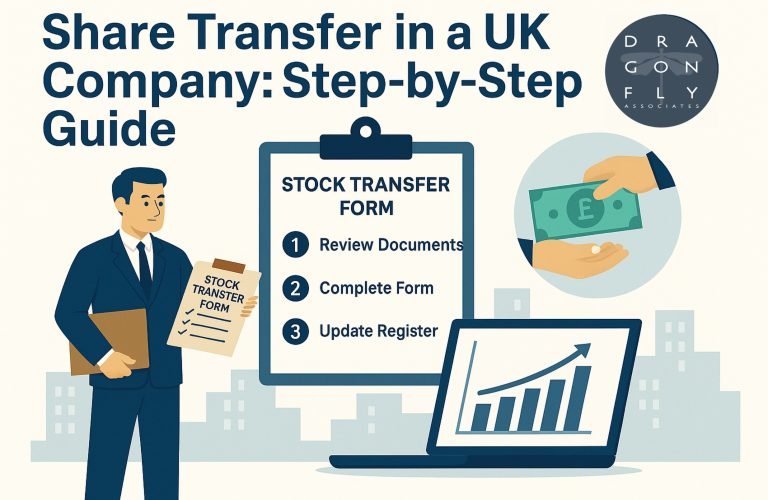
Transferring shares in a UK private limited company is a common business activity—whether to onboard new investors, update internal ownership, or exit a shareholder. But it must be done correctly to ensure legal validity and protect all parties involved.In this article, we explain how share transfers work, what documents are needed, and how Dragonfly Associates assists clients with compliant and structured transfers—subject to agreement.

What Is a Share Transfer?

A share transfer occurs when an existing shareholder sells or gives their shares to someone else. Unlike issuing new shares (which increases the total number of shares), a transfer redistributes the existing shareholding.

Reasons for share transfers include:

  • Bringing on a new business partner or investor
  • Exiting shareholders
  • Inheritance or family ownership restructuring
  • Shareholder buybacks

Transfers must be approved and recorded properly in the company’s statutory documents.


Step-by-Step: How to Transfer Shares in the UK

Step-by-Step - How to Transfer Shares in the UK

1. Review the Articles of Association and Shareholders’ Agreement

Check whether:

  • Pre-emption rights apply (existing shareholders must be offered the shares first)
  • Board or shareholder approval is required
  • Specific procedures or pricing conditions are set

Dragonfly Associates reviews your governing documents to ensure all rules are followed.

2. Complete a Stock Transfer Form (Form J30)

The form must include:

  • Name of current shareholder (transferor)
  • Name of new shareholder (transferee)
  • Number and class of shares
  • Date and value of transfer
  • Signature of transferor (and optionally transferee)

We prepare the stock transfer form for you and ensure the details match company records.

3. Pay Stamp Duty (if applicable)

If the transfer value exceeds £1,000, HMRC stamp duty of 0.5% applies. The buyer must:

  • Submit the form to HMRC for stamping (online or by post)
  • Pay the duty within 30 days of signing

We advise clients on whether stamp duty applies and assist with submission where required.

4. Update the Register of Members

Once the transfer is complete, you must:

  • Update the statutory register of members
  • Cancel and issue new share certificates
  • Record the transfer in board minutes

These steps formalise the change in ownership. We handle all documentation and register updates under our secretarial services.

5. Notify Companies House (if needed)

There’s no immediate obligation to notify Companies House for private companies. However, changes must appear in the next Confirmation Statement (CS01).

We ensure this update is included in your next CS01 filing.

Tax and Legal Considerations

  • Stamp duty (as noted)
  • Potential capital gains tax for the seller
  • Valuation considerations, especially in family or related-party transfers
  • Restrictions in shareholder agreements or company buy-back rules

We work alongside your accountant or legal adviser to ensure the transfer is valid, tax-compliant, and properly recorded.

Frequently Asked Questions

Can I transfer shares without paying anything?

Yes. Shares can be gifted, but documentation is still required and tax implications may apply.

Does the company need to approve the transfer?

Usually yes, especially if the Articles or Shareholders’ Agreement require board or member approval.

Can Dragonfly Associates manage the transfer for me?

Yes. We provide a full share transfer service, including form preparation, register updates, and guidance on compliance—subject to agreement.

Transfer Shares with Confidence

Whether you’re updating your cap table, restructuring ownership, or welcoming a new shareholder, a properly executed share transfer protects everyone involved and keeps your company compliant.

Dragonfly Associates offers end-to-end share transfer services, including document preparation, register updates, and optional HMRC assistance—available through our company management packages.

To begin a share transfer or review your shareholder structure, contact our team.

Last Updated: September 19, 2025
When setting up or managing a UK limited company, many directors wonder whether appointing a company secretary is mandatory—or even useful. While not always legally required, the role can be highly beneficial for compliance, governance, and efficiency.In this article, we explain whether your UK company needs a company secretary and how Dragonfly Associates provides secretarial support, subject to agreement.

Is a Company Secretary Legally Required?

In most cases, no. For private limited companies in the UK:

  • A company secretary is not legally required
  • The company’s directors can handle secretarial duties themselves

However, for public limited companies (PLCs), appointing a qualified company secretary is a legal requirement.

We advise private companies on whether appointing one is beneficial for their structure.

What Does a Company Secretary Do?

What Does a Company Secretary Do?

Even when optional, a company secretary can play a key role in corporate governance and compliance. Typical responsibilities include:

  • Maintaining statutory registers
  • Filing accounts and Confirmation Statements
  • Preparing board minutes and resolutions
  • Ensuring Companies House filings are made on time
  • Liaising with shareholders and regulators
  • Supporting board meetings and decisions
  • Handling share transfers and capital changes

Dragonfly Associates performs these functions for clients through our Company Secretarial Services—subject to service agreement.

Why Appoint a Company Secretary?

You may choose to appoint a secretary if:

  • You want to delegate compliance tasks
  • You have multiple shareholders or directors
  • You want stronger internal controls and documentation
  • You plan to attract investment or undergo due diligence
  • You want professional oversight without hiring in-house staff

Appointing a secretary gives you more structure—especially as your business grows.

How to Appoint a Company Secretary

To appoint a secretary:

  1. Pass a board resolution (if not already authorised in the Articles)
  2. File form AP03 with Companies House (for an individual) or AP04 (for a corporate entity)
  3. Update your company’s internal records and statutory registers

We prepare resolutions and file forms for clients enrolled in our secretarial or governance packages.

Can a Director Be the Company Secretary?

Yes, a director can also act as company secretary in a private limited company. However, in PLCs, the secretary must be qualified and independent from certain roles.

We help determine the best structure based on your company type and goals.

Frequently Asked Questions

Can I remove a company secretary later?

Yes. You can file form TM02 with Companies House and update your records. We assist with this process.

Will not having a secretary affect my compliance?

Not necessarily—but someone must perform those duties. Many directors find it easier to delegate these responsibilities.

Does Dragonfly Associates act as company secretary?

Yes. We offer named company secretary services and support clients with filings, register maintenance, and board documentation—subject to agreement.

Stay Compliant Without the Stress

You don’t need a company secretary to run a compliant company—but having one can help ensure your business runs smoothly, especially as it grows or seeks investment.

Dragonfly Associates provides tailored company secretarial services, including register updates, filings, and resolution drafting—offered as part of clearly defined compliance packages.

To discuss your company’s governance needs, contact our team.

Last Updated: September 19, 2025
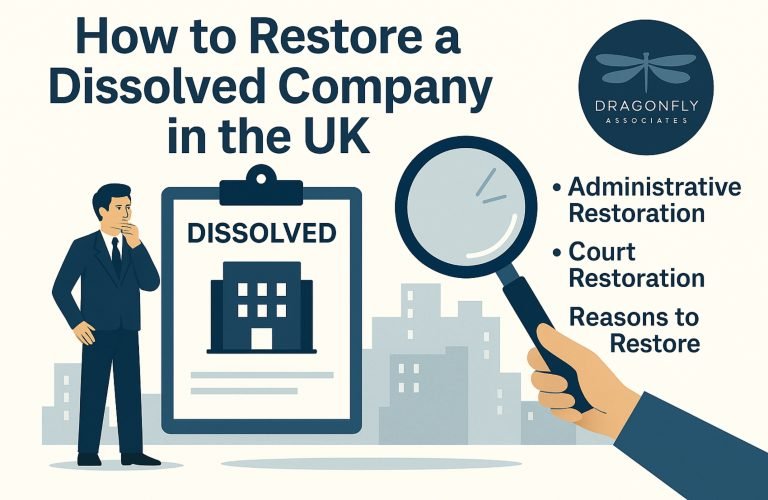
If your UK limited company has been dissolved—whether voluntarily or by action of Companies House—it may be possible to restore it to the register. Restoring a company allows you to continue trading, recover assets, or correct an administrative error.In this article, we explain when and how you can restore a dissolved company in the UK and how Dragonfly Associates supports clients through the process, subject to agreement.

What Does “Dissolved” Mean?

A dissolved company has been officially removed from the Companies House register. It is no longer a legal entity and cannot:

  • Trade or operate
  • Own property or bank accounts
  • Enter into contracts or be sued

All remaining assets at the time of dissolution become “bona vacantia”—the property of the Crown.
If the company was struck off in error or you need access to assets, restoration may be necessary.

Methods of Company Restoration

There are two main ways to restore a UK company:

  1. Administrative Restoration
  2. Court Restoration

Each method has different requirements and is used in different circumstances.

1. Administrative Restoration

Available if:

  • The company was struck off by Companies House (not voluntarily)
  • The application is made within 6 years of dissolution
  • The company was in compliance at the time of dissolution (or can bring filings up to date)
  • You were a director or shareholder at the time of dissolution

You must:

  • Submit form RT01
  • Provide a court fee and restoration fee
  • File all outstanding accounts and Confirmation Statements
  • Pay any penalties or late filing fees

Dragonfly Associates assists with form preparation, late filings, and correspondence with Companies House and HMRC as part of our restoration support service.

2. Court Restoration

Required if:

  • The company was dissolved voluntarily
  • You are not a former director or shareholder
  • More than 6 years have passed
  • You need to recover an asset or resolve a claim

This involves:

  • Filing a claim with the court
  • Providing evidence and legal reasoning
  • Serving notice on the Treasury Solicitor (if assets are involved)
  • Attending a court hearing

We can help coordinate with legal professionals for complex restorations and provide background support throughout the process.

Reasons to Restore a Dissolved Company

Reasons to Restore a Company

  • To recover assets or funds still held in the company name
  • To re-commence trading under a previous brand
  • To correct an error or wrongful strike-off
  • To respond to legal or financial obligations arising after dissolution

Our team helps assess whether restoration is viable and worthwhile based on your goals.

Consequences of Restoration

Once restored:

  • The company is deemed to have continued in existence as if it were never dissolved
  • All obligations resume, including annual accounts, tax filings, and statutory registers
  • Any legal claims against or by the company may be revived

We help bring your company’s records up to date and re-establish compliance post-restoration.

Frequently Asked Questions

How long does restoration take?

Administrative restoration usually takes 2–3 months. Court restoration may take longer due to legal proceedings.

Can I restore a company just to access its bank account?

Yes, if the account was still open at dissolution. The funds become Crown property unless the company is restored.

Do I need to repay unpaid penalties?

Yes. All outstanding accounts, fees, and penalties must be resolved as part of the restoration process.

Bring Your Company Back the Right Way

Restoring a dissolved company is a legal and administrative process—but it’s often worth the effort if valuable assets, contracts, or branding are involved.

Dragonfly Associates provides tailored support for administrative restoration, including form preparation, Companies House filings, and catch-up compliance—offered under agreed service packages.

If your company was dissolved and you need help bringing it back, contact our team today.

Last Updated: September 19, 2025
If you’ve been appointed as a director of a UK limited company, you’re not just a figurehead—you have legal obligations under the Companies Act 2006. Understanding these duties is critical to avoiding liability, protecting your company, and maintaining public trust.In this article, we outline the main responsibilities of UK company directors and how Dragonfly Associates helps clients stay informed and compliant, subject to agreement.

What Is a Director?

A company director is someone appointed to manage a company on behalf of its shareholders. You don’t have to be a shareholder yourself—but once appointed, your decisions and actions must serve the company’s interests and comply with the law.

Directors can be:

  • Executive (involved in daily operations)
  • Non-executive (strategic oversight)
  • Sole (if you’re the only director and shareholder)

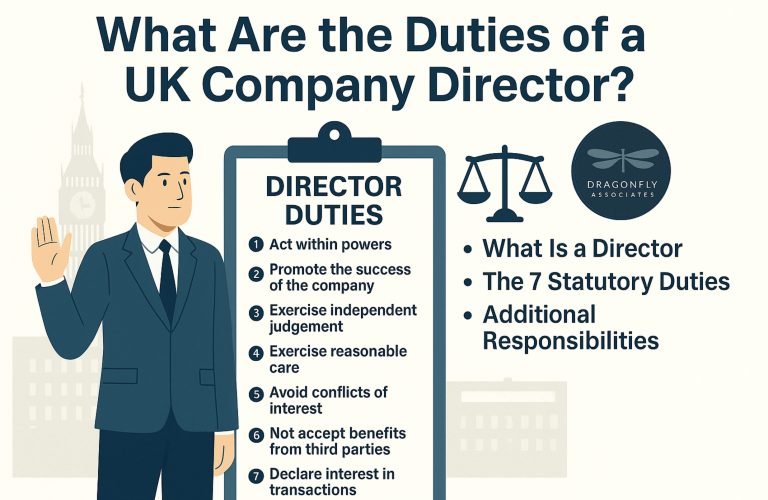
The 7 Statutory Duties of Directors

Under the Companies Act 2006, directors must observe the following seven duties:

  1. Act within their powers
    Follow the rules set out in the company’s Articles of Association.
  2. Promote the success of the company
    Make decisions that benefit the company’s long-term success and take into account employees, shareholders, customers, and the community.
  3. Exercise independent judgment
    Use your own reasoning and judgment, even when seeking outside advice.
  4. Exercise reasonable care, skill, and diligence
    Meet the standards expected of a competent person with your role and knowledge.
  5. Avoid conflicts of interest
    Disclose and manage any personal or financial interests that could influence your decisions.
  6. Not accept benefits from third parties
    Avoid gifts or rewards that may be seen as a conflict of interest.
  7. Declare interest in proposed transactions or arrangements
    Disclose to the board any interest you have in a transaction the company is considering.

Dragonfly Associates helps new directors understand these duties during onboarding and offers ongoing guidance under service agreement.

Directors' Additional Legal Responsibilities

Additional Legal Responsibilities

Directors are also responsible for:

  • Filing annual accounts and Confirmation Statements
  • Maintaining accurate company records (registers, minutes, etc.)
  • Ensuring the company pays the correct taxes on time
  • Operating payroll and deducting PAYE/NI correctly (if applicable)
  • Ensuring the company complies with GDPR and health & safety laws (where relevant)

We support compliance through managed filings, tax coordination, and registered office services depending on your selected plan.

Personal Liability and Risk

While a limited company offers legal protection, directors may still be held personally liable in cases of:

  • Fraud or deliberate misconduct
  • Wrongful or fraudulent trading
  • Breach of duties or fiduciary responsibilities
  • Failing to act in the best interest of the company

Having the right procedures and documentation in place is essential. We help directors avoid common pitfalls with proactive support.

Can a Director Be Removed?

Yes. A director may be removed by:

  • Resignation
  • Shareholder resolution under the Companies Act
  • Breach of contract or performance concerns (subject to agreements)

Dragonfly Associates helps companies follow the correct procedure for appointment or removal of directors, including documentation and Companies House filings.

Frequently Asked Questions

Can I be a director of more than one company?

Yes. There’s no legal limit, but you must manage each company’s obligations separately.

Can a non-UK resident be a director?

Yes. UK companies can have non-UK resident directors, as long as at least one human director is appointed.

Do I need to be a shareholder to be a director?

No. Directors and shareholders are legally distinct roles, though one person can hold both.

Lead Your Company Responsibly

Being a company director is both a privilege and a legal responsibility. By understanding your duties and seeking professional support, you can lead confidently and avoid costly errors.

Dragonfly Associates guides directors at every stage—from formation and appointments to annual filings and ongoing compliance—available under defined service agreements.

To ensure you’re fulfilling your obligations as a UK company director, contact us today.

Last Updated: September 19, 2025
There may come a time when your UK company has fulfilled its purpose or is no longer needed. In such cases, closing the company correctly is essential to avoid penalties, ongoing filing obligations, or legal complications.This article explains how to dissolve a UK limited company, what steps to follow, and how Dragonfly Associates assists clients with the process—subject to agreement.

What Is Company Dissolution?

Company dissolution is the formal process of removing a company from the Companies House register. Once dissolved, the company ceases to exist as a legal entity and can no longer trade or own assets.

Dissolution is suitable for companies that:

  • Have ceased trading
  • Have no outstanding debts or liabilities
  • Have no assets or bank accounts remaining
  • Are not involved in ongoing legal proceedings

If your company is still active or has liabilities, you may need to follow an alternative route (e.g. liquidation or striking off after a winding-up).

Key Requirements Before Applying

Before applying to dissolve your company, you must ensure:

  • All trading has ceased (minimum 3 months)
  • All assets have been distributed (e.g. bank accounts closed)
  • All debts have been settled
  • Final accounts and tax returns have been submitted to HMRC
  • Employees have been properly offboarded and PAYE closed
  • VAT registration (if any) has been cancelled

We assist clients with a final compliance review to ensure these requirements are met before filing for dissolution.

Step-by-Step: How to Dissolve a UK Company

Step-by-Step: How to Dissolve a UK Company

Step-by-Step: How to Dissolve a UK Company

  1. Board or shareholder approval (where necessary)
  2. Final accounts submitted to HMRC and Companies House
  3. Form DS01 completed and signed by the majority of directors
  4. DS01 submitted to Companies House with the appropriate fee
  5. Public notice of intent to dissolve is published in The Gazette
  6. If no objections are raised, the company is removed from the register after 2 months

Dragonfly Associates prepares the DS01 form, files it, and tracks the dissolution timeline as part of our closure support services.

Important Considerations

  • You must inform any stakeholders (e.g. creditors, shareholders, employees)
  • If the company is dissolved with outstanding debts, it may be restored and directors held personally liable
  • Assets still in the company at the point of dissolution become property of the Crown (bona vacantia)

We help ensure your company is fully settled before final dissolution to avoid legal or financial consequences.

Alternatives to Dissolution

If your company is dormant or temporarily inactive but may be reactivated, you can:

  • File dormant company accounts annually
  • Maintain a registered office and file Confirmation Statements

If your company has debts or insolvency risks, you may need to consider:

  • Members’ Voluntary Liquidation (MVL)
  • Creditors’ Voluntary Liquidation (CVL)

We can provide referrals to licensed insolvency practitioners where appropriate.

Frequently Asked Questions

Can I dissolve my company if it still has a bank account?

No. All accounts and assets must be closed or transferred before filing Form DS01.

Will HMRC object to my application?

If you owe tax or haven’t filed recent returns, HMRC may object to your dissolution. We help resolve any outstanding obligations beforehand.

Can I restart a dissolved company later?

No. Once dissolved, the company is no longer legally valid. You would need to register a new company or apply for administrative restoration (which is complex and time-sensitive).

Close Your Company the Right Way

Dissolving a UK company is a formal legal process—not just a decision to stop trading. With proper planning and compliance, it can be completed smoothly and without complications.

Dragonfly Associates supports clients through company closure, ensuring all filings, forms, and compliance obligations are handled professionally—subject to agreement.

To close your UK company properly, contact our team for dissolution support and guidance.

Last Updated: September 19, 2025
Shares represent ownership in a company—but not all shares are equal. UK companies can issue different classes of shares to reflect varying levels of control, voting rights, dividends, or risk.In this article, we explore what share classes are, why companies use them, and how Dragonfly Associates helps structure and issue the right classes of shares—subject to agreement.

What Is a Share Class?

A share class defines a group of shares that carry the same rights and conditions. Different classes allow a company to differentiate:

  • Voting rights
  • Dividend entitlement
  • Rights on liquidation
  • Ability to transfer or redeem shares

This flexibility is useful when balancing founder control, investor participation, employee incentives, or family ownership.

Common Share Classes in UK Private Companies

Here are the most frequently used share classes:

  • Ordinary Shares – standard shares with full voting, dividend, and capital rights.
  • A/B/C Shares – subclasses of ordinary shares with varied rights, often used to separate founders, investors, or employees.
  • Non-Voting Shares – carry dividend rights but no voting power.
  • Preference Shares – offer a fixed dividend and priority return of capital, usually with limited or no voting rights.
  • Redeemable Shares – can be bought back by the company at a future date, under agreed terms.
  • Growth Shares – allow shareholders to benefit from future growth only, often used for incentivising employees.

Dragonfly Associates assists in drafting Articles of Association or Shareholder Agreements to reflect these distinctions where required.

Why Use Different Share Classes?

Why Use Different Share Classes?

Companies create multiple share classes to:

  • Attract investment without diluting control
  • Reward employees with equity but limit voting rights
  • Distinguish founder shares from passive investor shares
  • Facilitate dividend payments based on performance or agreement
  • Plan for future exits or share buybacks

We help businesses structure their share capital in line with their goals, subject to agreement and proper legal review.

Legal Considerations

When creating or altering share classes, you must:

  • Update your Articles of Association (if rights differ from default)
  • Pass a shareholder resolution approving the changes
  • Issue appropriate share certificates
  • File relevant forms with Companies House (e.g. SH01 for allotments, SH08 for changes to rights)

Dragonfly Associates prepares these documents and ensures compliance through our secretarial services, where applicable.

Tax and Investment Implications

Share classes can affect:

  • Eligibility for SEIS/EIS tax reliefs
  • Director and employee tax treatment
  • Control thresholds for decision-making
  • Valuation for fundraising or sale

We recommend reviewing share structuring with your accountant or tax advisor. We work alongside your advisers to document the structure correctly.

Frequently Asked Questions

Can I issue different share classes after incorporation?

Yes. You can amend your share structure at any time by passing a resolution and updating Companies House.

Do different share classes affect Company House filings?

Yes. You must declare the class of each share and its rights in your Confirmation Statement and statutory filings.

Can employees receive shares with limited rights?

Yes. Many companies issue non-voting or growth shares to staff, especially in startup environments. We help draft the appropriate terms.

Build the Right Capital Structure from the Start

Whether you’re onboarding investors, launching an employee incentive plan, or simply planning for the future, share classes give you flexibility without compromising control—if structured properly.

Dragonfly Associates helps you define, issue, and document share classes in accordance with UK company law—available under clearly defined service agreements.

To explore or update your company’s share structure, contact our team today.

© All rights reserved. Made with love by Ottmann-Polignac

4tehrwq

Congratulations! This company name is available.

4tehrwq

Unfortunately, this name is not available for registration.
Please select another.