
One of the key decisions UK company directors face is how to pay themselves: via salary, dividends, or a combination of both. The method you choose can significantly impact your tax liability, National Insurance contributions, and company cash flow.
In this article, we compare director’s salary and dividends in terms of tax efficiency, control, and compliance. Dragonfly Associates provides tailored advice and payroll support based on your chosen structure, subject to agreement.
A salary is a fixed payment made by your company to you as an employee or director. It’s subject to:
Dividends are payments made from a company’s post-tax profits to its shareholders. They are not treated as business expenses and are taxed at different (often lower) rates.
To receive dividends, you must:
Pros:
Cons:
We assist directors in setting up payroll and calculating optimal low-salary thresholds, depending on your overall compensation strategy.
Pros:
Cons:
Dragonfly Associates helps ensure dividends are declared in line with HMRC guidelines and documented appropriately.

Most directors choose a hybrid approach:
This method offers balance between tax efficiency, pension eligibility, and compliance. We calculate and manage this structure for clients under our payroll and tax service plans.
Director taking:
Approximate personal tax due:
Compared to full salary equivalent, this approach can yield thousands in tax savings annually, subject to compliance and cash availability.
Dragonfly Associates provides end-to-end support for director remuneration, helping you remain tax-efficient and compliant.
Yes, but this may not be optimal. You miss out on pension credits and may attract HMRC scrutiny. We advise a balanced approach.
No. Dividends are reported via your personal Self Assessment return and taxed separately from salary.
Yes. Even low salaries must be processed through PAYE and reported to HMRC. We handle this on your behalf where applicable.
Choosing the right mix of salary and dividends can make a meaningful difference in your take-home pay and long-term planning. But it must be done correctly to avoid penalties or HMRC audits.
Dragonfly Associates offers personalised director remuneration guidance, payroll setup, and dividend compliance—subject to agreement and your selected support plan.
To discuss the most efficient way to pay yourself, contact our team today.
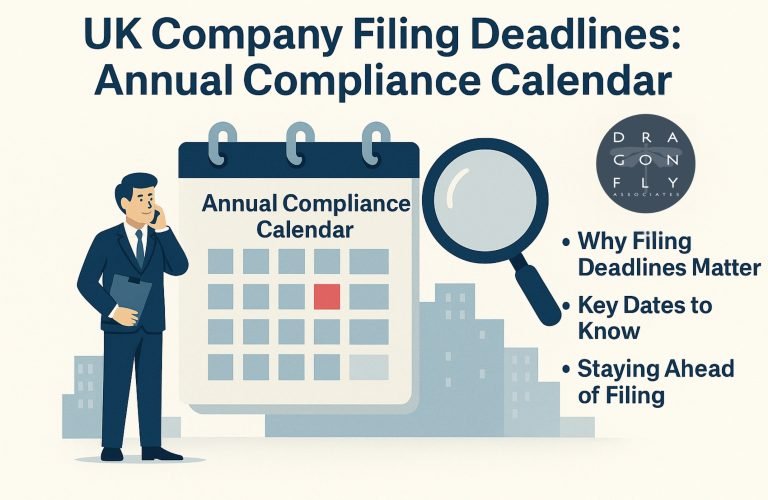
Keeping your UK company compliant isn’t just about staying in business—it’s about avoiding costly penalties and maintaining your company’s reputation. One of the most common mistakes made by directors is missing key deadlines.
This article outlines the most important UK company filing dates you need to know, and how Dragonfly Associates helps clients stay ahead—subject to agreement.
Dragonfly Associates tracks your deadlines, sends alerts, and handles filings under our annual compliance packages.

Here’s a breakdown of the most common filing obligations for private limited companies in the UK:
| Filing Type | Deadline (After Event) | Notes |
|---|---|---|
| Confirmation Statement (CS01) | 14 days after confirmation date | Due annually, confirms company information |
| Annual Accounts (first year) | 21 months after incorporation | For new companies only |
| Annual Accounts (ongoing) | 9 months after accounting year-end | Applies from second year onward |
| Corporation Tax Return (CT600) | 12 months after accounting year-end | Filed with HMRC |
| Corporation Tax Payment | 9 months + 1 day after accounting year-end | Must be paid before CT600 is filed |
| PAYE / NI Payments (monthly) | 22nd of each month (if paying electronically) | For employers |
| VAT Returns (if registered) | Usually quarterly – 1 month + 7 days after VAT period | Depends on VAT scheme used |
| Companies House Event Changes | Within 14 days of change (e.g. director, address) | File appropriate form (e.g. CH01, AD01) |
Dragonfly Associates offers full annual compliance monitoring, filings, and documentation maintenance to eligible clients—subject to agreement.
We help prevent this through deadline tracking and proactive filing.
Yes. You can apply to shorten or extend your accounting period with Companies House. We can assist with the application.
Contact us immediately. We may be able to help file quickly and mitigate penalties or objections, depending on the situation.
Yes. We provide comprehensive annual filing support, including accounts, Confirmation Statements, tax returns, and more—subject to agreement.
Running a company involves more than great ideas—it requires staying compliant with UK filing obligations. By knowing your key dates and working with the right partners, you can stay ahead and avoid unnecessary risk.
Dragonfly Associates tracks your filing calendar, handles all required submissions, and provides ongoing advice through our compliance and accounting service plans.
To simplify your company’s compliance and never miss a deadline again, contact us today.

Claiming legitimate business expenses is one of the most effective ways to reduce your UK company’s taxable profit and Corporation Tax bill. But many directors overlook key deductions—or claim incorrectly, leading to penalties or rejected returns.
In this article, we explain what business expenses are, which ones are allowable, and how Dragonfly Associates helps clients optimise and document expense claims, subject to agreement.
Business expenses are costs your company incurs “wholly and exclusively” for the purpose of running the business. If allowable, these expenses can be deducted from your taxable profits before calculating Corporation Tax.
Properly documenting your expenses is essential. HMRC may request records at any time, so maintaining accurate receipts and categorisation is a legal requirement.
Here are typical expenses that most UK limited companies can claim:
Dragonfly Associates helps classify and record these expenses correctly through our bookkeeping and accounting support packages.
If you work from home, your company may be able to reimburse:
This must be calculated and justified carefully. We provide home-working expense templates and guidance for directors using part of their home for business.

Company directors and staff may also claim expenses for:
These must be reimbursed through the payroll or recorded via expense reports. We advise on compliant procedures and integrate claims into our payroll services where applicable.
You may not claim:
Claiming non-allowable expenses can result in penalties or tax adjustments. We help ensure all submissions meet HMRC standards.
To support any claim, HMRC expects:
Dragonfly Associates offers digital bookkeeping solutions that allow clients to scan and categorise expenses securely—depending on your selected support plan.
Yes, in some cases. Pre-trading costs can be claimed if they would have been deductible had the company been active. These must be recorded separately.
Yes. It’s best practice to keep personal and business expenses separate for clarity and compliance.
Yes, provided the expense was wholly for business purposes. We recommend maintaining clear documentation and using an expense claim form.
Understanding what expenses your UK company can claim is essential to efficient tax planning. Done properly, it reduces your Corporation Tax liability while keeping your business compliant.
Dragonfly Associates helps clients set up, manage, and optimise expense tracking systems, offering tailored advice and documentation as part of our accounting packages—subject to agreement.
To ensure you’re claiming everything you’re entitled to (and nothing you’re not), contact our team today.

If your UK company intends to pay salaries to employees—or to directors—you may be legally required to register for PAYE (Pay As You Earn). This system ensures that income tax and National Insurance contributions are deducted at source and reported to HMRC.
In this guide, we explain what PAYE is, when registration is required, and how Dragonfly Associates assists clients with setup and compliance, subject to agreement.
PAYE stands for Pay As You Earn. It is HMRC’s system for collecting:
The PAYE system applies to most employees and directors who receive regular payments above a certain threshold.
You must register for PAYE if you:
Even if your director is the only person on payroll, registration may be required if their salary exceeds the NIC threshold.
Dragonfly Associates evaluates your structure and advises whether PAYE is needed, as part of our company setup or accounting support.
You do not need to register for PAYE if:
However, you must still keep payroll records, and may need to register later if the situation changes. We help you monitor this threshold and prepare for future obligations.

You register for PAYE through HMRC’s online portal. You’ll need:
Once registered, you’ll receive:
Dragonfly Associates registers PAYE schemes for clients as part of agreed payroll or compliance packages.
Once your PAYE scheme is active, you must:
We provide full-service payroll management or software guidance depending on your selected service plan.
Directors are treated slightly differently in PAYE:
Dragonfly Associates advises on optimal director salary strategies and ensures your payroll is configured accordingly.
Only if your salary is below the lower earnings limit and you’re not providing benefits. In most cases, directors require PAYE registration if paid.
No. PAYE registration must be done in advance of making payments. Failing to register on time can lead to penalties.
Yes. You must file a “nil return” or tell HMRC that no payments were made for the period. We assist with this under payroll support plans.
PAYE isn’t just for big businesses—it applies to any company paying salaries. Failing to register or report correctly can result in penalties, even for first-time directors.
Dragonfly Associates supports companies with PAYE setup, payroll administration, and HMRC reporting under agreed service plans.
If you plan to pay yourself or hire staff, contact us early to ensure everything is in place.
VAT (Value Added Tax) is one of the most commonly misunderstood taxes for new and growing businesses in the UK. Depending on your revenue and business activities, you may be legally required to register—or you may benefit from registering voluntarily.
This guide explains when VAT registration is mandatory, what it means for your business, and how Dragonfly Associates can support the process, subject to agreement.
VAT is a consumption tax added to most goods and services sold in the UK. When your business is VAT registered:
The standard VAT rate in the UK is 20%, though reduced rates (5% or 0%) apply to some goods and services.
You must register for VAT if:
This applies to UK-based and non-UK businesses with a UK VAT presence. Dragonfly Associates monitors thresholds and advises clients when registration becomes necessary.
Even if you’re under the threshold, you may choose to register voluntarily. This can be beneficial if:
However, it also adds administrative obligations—quarterly returns, invoice requirements, and proper recordkeeping. We help you assess whether voluntary registration makes sense based on your business model.
You can register online through the HMRC VAT portal. You’ll need:
Once registered, HMRC will issue:
Dragonfly Associates handles the VAT registration process for clients under our accounting and compliance plans, subject to agreement.
Several VAT accounting schemes are available, including:
Each has pros and cons depending on your business type, cash flow, and reporting needs. We guide clients in choosing the right scheme for their circumstances.
Once VAT registered, you must:
Failure to comply can result in penalties, fines, or deregistration. Dragonfly Associates provides full VAT return preparation and filing services to clients who opt in, where applicable.
You still need to register if the threshold is exceeded, even if only briefly. You can apply to deregister later if appropriate.
You may be able to reclaim VAT on certain pre-registration expenses (up to 6 months for services, 4 years for goods), depending on conditions.
HMRC may impose penalties and demand backdated VAT, plus interest.
A UTR (Unique Taxpayer Reference) is a 10-digit number issued by HMRC that uniquely identifies your company for tax purposes. You’ll need it when registering for Corporation Tax and filing your tax returns. It’s sent by post shortly after your company is incorporated.
VAT doesn’t need to be complicated—but the risks of getting it wrong are real. Whether you’re registering for the first time or deciding if voluntary registration makes sense, it pays to have expert support.
Dragonfly Associates helps UK and international businesses register, file, and manage their VAT obligations with clarity and precision—available as part of agreed service packages.
To discuss your VAT status or begin the registration process, contact us today.
If your UK limited company is active—meaning it’s trading, investing, or earning income—it must pay Corporation Tax on its profits. Unlike VAT or PAYE, there is no threshold: registration is mandatory for every active company.
In this article, we explain what Corporation Tax is, when to register, and how Dragonfly Associates can help you manage your tax obligations, subject to agreement.
Corporation Tax is a direct tax that UK companies pay on their taxable profits. This includes:
The current Corporation Tax rate (as of 2025) is 25% for profits over £250,000. Small companies with profits under £50,000 pay a lower marginal rate. There is a tapered rate in between.
These rates can change annually, so it’s important to stay informed or work with a provider who keeps you compliant.
You must register for Corporation Tax if your company is:
Even if your company is not making a profit, you still need to file a Corporation Tax return if the company is active.
Dragonfly Associates registers clients for Corporation Tax as part of our company formation and accounting packages, where applicable.
You must register with HMRC within 3 months of starting to trade. “Trading” includes invoicing, advertising, receiving payments, or buying stock.
Registration is done online via the HMRC portal. Once registered, HMRC will:
We handle registration and setup for clients enrolled in our tax and compliance support plans.
Missing deadlines can result in penalties and interest charges. Dragonfly Associates monitors these dates for our clients, where agreed.
Your tax return must show:
It must be filed online in iXBRL format and usually submitted alongside your annual accounts.
We prepare and submit Corporation Tax returns for clients using our accounting services, depending on their service plan.
To reduce your tax liability, your company can deduct allowable business expenses, such as:
You may also qualify for reliefs like:
Dragonfly Associates provides guidance on allowable expenses and ensures they’re recorded properly, subject to agreement.
Yes, but many business owners prefer professional assistance to ensure accuracy and avoid penalties.
No. But you must inform HMRC that your company is dormant. Otherwise, you may still receive filing requests.
HMRC may fine your company and backdate tax liabilities. You could also face late payment penalties.
Corporation Tax is one of the most important obligations your company will face. With clear processes, good recordkeeping, and proactive support, it doesn’t have to be a burden.
Dragonfly Associates helps businesses register, file, and manage their Corporation Tax duties with clarity and care—available under contract and according to your selected service level.
To ensure your company meets its tax obligations from day one, get in touch with our team.

