Last Updated: September 19, 2025
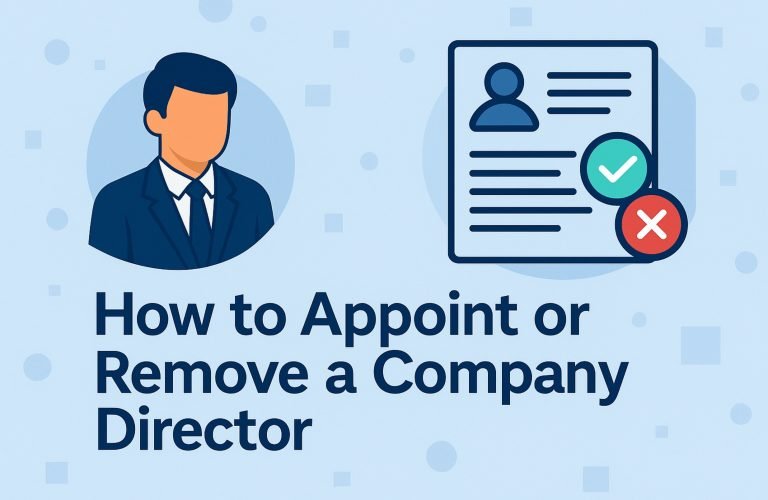
Company directors play a vital role in managing a UK limited company, but changes to the board are common—especially during growth, restructuring, or in response to shareholder decisions.In this article, we explain how to legally appoint or remove a director in a UK company and how Dragonfly Associates supports you through documentation and filing, subject to agreement.

Who Can Be a Director?

  • At least 16 years old
  • A natural person (not a corporate body, unless alongside human directors)
  • Not disqualified from acting as a director under UK law
  • Of sound mind and legal standing

There’s no UK residency requirement. Many international clients serve as directors of UK companies from abroad.

Appointing a New Director

Step 1: Check the Company’s Articles of Association

Before appointing a director, review the Articles of Association and any shareholder agreements. These documents may outline:

  • Who has authority to appoint
  • Any restrictions or voting thresholds
  • Rights of existing directors or shareholders

We help clients review these documents before proceeding.

Step 2: Obtain Necessary Approval

  • For most private companies, the board of directors can approve the appointment by majority resolution.
  • In some cases, shareholder approval may also be required.

Dragonfly Associates prepares board minutes and resolutions as part of our company secretarial services, where applicable.

Step 3: Notify Companies House

You must notify Companies House within 14 days by filing form AP01 (for an individual) or AP02 (for a corporate director).
Details required include:

  • Full name
  • Date of birth
  • Nationality
  • Occupation
  • Service address (can be a professional service address)

We handle the AP01/AP02 filing on behalf of clients using our director support packages.

Removing a Director

How to Remove a Company Director

A director can leave the board voluntarily—or be removed by shareholders or fellow directors in accordance with the law and company rules.

Step 1: Review the Articles and Agreements

Check if:

  • The director has a fixed term
  • Special procedures apply for removal
  • There are rights to notice, compensation, or appeal

We help assess legal risks before action is taken.

Step 2: Resignation or Shareholder Resolution

A director can resign by submitting a signed letter. The board should record this via a board resolution and file the change at Companies House.

If shareholders seek to remove a director (without resignation), they must:

  • Give special notice
  • Hold a general meeting
  • Pass an ordinary resolution with majority support

This process must be documented carefully. We can support drafting and guidance where agreed.

Step 3: File Form TM01

Form TM01 must be submitted to Companies House within 14 days of the director ceasing their role. We take care of this form and register update where included in your compliance plan.

What Happens After a Change?

  • Update the statutory register of directors
  • Notify relevant stakeholders, banks, and accountants
  • Ensure any director service address is updated or removed
  • Adjust internal access rights and contracts

We help maintain the company register and handle post-removal updates for clients under our secretarial services.

Frequently Asked Questions

Can I be the only director of my company?

Yes, a private limited company can operate with one director who is also the sole shareholder.

Do I need to notify Companies House?

Yes. Appointments and terminations must be reported within 14 days using the correct forms (AP01, TM01).

Can a director be removed without their consent?

Yes, under the Companies Act 2006, shareholders may remove a director by ordinary resolution—provided proper procedure is followed.

Make Director Changes with Clarity

Appointing or removing a director is a normal part of business—but it must be handled correctly to avoid legal or operational complications.

Dragonfly Associates provides full support for director appointments, resignations, and removals, including legal review, resolution drafting, and Companies House filings—delivered under agreed service plans.

To manage your board effectively and stay compliant, contact us today.

Last Updated: September 19, 2025

One of the key decisions UK company directors face is how to pay themselves: via salary, dividends, or a combination of both. The method you choose can significantly impact your tax liability, National Insurance contributions, and company cash flow.

In this article, we compare director’s salary and dividends in terms of tax efficiency, control, and compliance. Dragonfly Associates provides tailored advice and payroll support based on your chosen structure, subject to agreement.

What’s the Difference Between Salary and Dividends?

A salary is a fixed payment made by your company to you as an employee or director. It’s subject to:

  • PAYE income tax
  • Employee National Insurance
  • Employer National Insurance

Dividends are payments made from a company’s post-tax profits to its shareholders. They are not treated as business expenses and are taxed at different (often lower) rates.

To receive dividends, you must:

  • Be a shareholder of the company
  • Have sufficient retained profits
  • Properly declare and minute the dividend payment

Option 1: Paying Yourself a Salary

Pros:

  • Qualifies for state pension contributions and personal allowances
  • Offers consistent income and easier mortgage/loan applications
  • Reduces Corporation Tax (as salary is an allowable expense)

Cons:

  • Subject to income tax and National Insurance
  • Requires PAYE registration and regular payroll filings
  • Less tax-efficient at higher income levels

We assist directors in setting up payroll and calculating optimal low-salary thresholds, depending on your overall compensation strategy.

Option 2: Paying Yourself Through Dividends

Pros:

  • Typically more tax efficient than salary at higher income levels
  • No National Insurance contributions
  • Flexibility to issue when cash flow allows

Cons:

  • Only payable from retained profits (after Corporation Tax)
  • Must be declared properly via board minutes
  • Doesn’t qualify for pension or employment benefits
  • Cannot be used to reduce Corporation Tax

Dragonfly Associates helps ensure dividends are declared in line with HMRC guidelines and documented appropriately.

Combined Approach: The Most Common Strategy

What’s More Tax Efficient? Combined Approach - The Most Common Strategy

Most directors choose a hybrid approach:

  • Pay a low salary (typically between £9,000–£12,570/year) to stay below or near tax/NIC thresholds
  • Top up with dividends to benefit from lower personal tax rates

This method offers balance between tax efficiency, pension eligibility, and compliance. We calculate and manage this structure for clients under our payroll and tax service plans.

Tax Comparison Example (2025/26 rates)

Director taking:

  • £12,570 salary (below income tax threshold)
  • £30,000 in dividends

Approximate personal tax due:

  • £0 income tax on salary
  • ~£1,450 tax on dividends after allowance
  • No National Insurance (salary below threshold)

Compared to full salary equivalent, this approach can yield thousands in tax savings annually, subject to compliance and cash availability.

Compliance Considerations

  • PAYE must be operated for salaries
  • Dividends must be from actual profits—not anticipated revenue
  • Dividend payments must be supported by board minutes and vouchers
  • All payments must be recorded properly in company and personal accounts

Dragonfly Associates provides end-to-end support for director remuneration, helping you remain tax-efficient and compliant.

Frequently Asked Questions

Can I take only dividends and no salary?

Yes, but this may not be optimal. You miss out on pension credits and may attract HMRC scrutiny. We advise a balanced approach.

Are dividends taxed through PAYE?

No. Dividends are reported via your personal Self Assessment return and taxed separately from salary.

Do I need to run payroll for a low salary?

Yes. Even low salaries must be processed through PAYE and reported to HMRC. We handle this on your behalf where applicable.

Optimise Your Director Pay with Expert Support

Choosing the right mix of salary and dividends can make a meaningful difference in your take-home pay and long-term planning. But it must be done correctly to avoid penalties or HMRC audits.

Dragonfly Associates offers personalised director remuneration guidance, payroll setup, and dividend compliance—subject to agreement and your selected support plan.

To discuss the most efficient way to pay yourself, contact our team today.

Last Updated: September 19, 2025

Keeping your UK company compliant isn’t just about staying in business—it’s about avoiding costly penalties and maintaining your company’s reputation. One of the most common mistakes made by directors is missing key deadlines.

This article outlines the most important UK company filing dates you need to know, and how Dragonfly Associates helps clients stay ahead—subject to agreement.

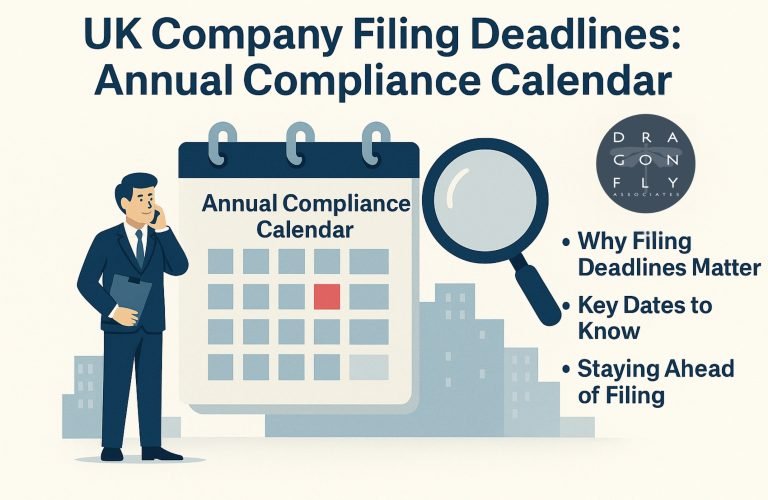
Why Filing Deadlines Matter

  • Financial penalties
  • Company strike-off warnings
  • Loss of good standing with Companies House or HMRC
  • Difficulty obtaining loans, investors, or credit

Dragonfly Associates tracks your deadlines, sends alerts, and handles filings under our annual compliance packages.

Key Filing Deadlines for UK Companies


Key Filing Deadlines for UK Companies

Here’s a breakdown of the most common filing obligations for private limited companies in the UK:

Filing Type Deadline (After Event) Notes
Confirmation Statement (CS01) 14 days after confirmation date Due annually, confirms company information
Annual Accounts (first year) 21 months after incorporation For new companies only
Annual Accounts (ongoing) 9 months after accounting year-end Applies from second year onward
Corporation Tax Return (CT600) 12 months after accounting year-end Filed with HMRC
Corporation Tax Payment 9 months + 1 day after accounting year-end Must be paid before CT600 is filed
PAYE / NI Payments (monthly) 22nd of each month (if paying electronically) For employers
VAT Returns (if registered) Usually quarterly – 1 month + 7 days after VAT period Depends on VAT scheme used
Companies House Event Changes Within 14 days of change (e.g. director, address) File appropriate form (e.g. CH01, AD01)


How to Stay Compliant All Year Round

  • Use accounting software with compliance reminders
  • Work with a provider that monitors dates on your behalf
  • Store your authentication code securely for quick online filing
  • Review your company register regularly

Dragonfly Associates offers full annual compliance monitoring, filings, and documentation maintenance to eligible clients—subject to agreement.

Penalties for Late Filing

  • Companies House penalties (starting at £150 and rising to £1,500+)
  • Strike-off procedures for missed filings or unpaid penalties
  • HMRC interest charges or late payment fines
  • Director disqualification in severe cases

We help prevent this through deadline tracking and proactive filing.

Frequently Asked Questions

Can I change my year-end?

Yes. You can apply to shorten or extend your accounting period with Companies House. We can assist with the application.

What if I miss a deadline?

Contact us immediately. We may be able to help file quickly and mitigate penalties or objections, depending on the situation.

Can Dragonfly Associates manage all filings for me?

Yes. We provide comprehensive annual filing support, including accounts, Confirmation Statements, tax returns, and more—subject to agreement.

Never Miss a Deadline Again

Running a company involves more than great ideas—it requires staying compliant with UK filing obligations. By knowing your key dates and working with the right partners, you can stay ahead and avoid unnecessary risk.

Dragonfly Associates tracks your filing calendar, handles all required submissions, and provides ongoing advice through our compliance and accounting service plans.

To simplify your company’s compliance and never miss a deadline again, contact us today.

Last Updated: September 19, 2025
In the UK, most company filings are now done online through Companies House WebFiling. To access your company’s records, make updates, or submit forms, you need one critical piece of information: your company authentication code.This article explains what the Companies House authentication code is, why it’s important, and how Dragonfly Associates helps clients manage their codes securely—subject to agreement.

What Is the Authentication Code?

The authentication code is a 6-character alphanumeric password assigned to your company by Companies House.

It acts as your digital signature and verifies that the person making online filings (e.g. changes to directors, registered office, share capital) is authorised to do so.

Think of it as your company’s filing password.

When Do You Need the Code?

You’ll need your authentication code to:

  • File Confirmation Statements (CS01)
  • Update director or shareholder details
  • Change the company’s registered office
  • File annual accounts or make corrections
  • Submit share allotments (SH01), changes (SH02), or capital statements
  • Authorise third-party providers or software

Dragonfly Associates uses the authentication code to file statutory documents on behalf of clients, where agreed.

How Do You Get It?

You’ll receive the authentication code when you:

  • Form your company using Companies House directly
  • Form your company through a registered agent (the agent may receive the code first)

It is posted to your registered office address for security purposes.

We ensure our clients receive their code securely, and we store it safely as part of our ongoing compliance services.


Lost or Forgotten Your Authentication Code?

Lost or Forgotten Your Code?

If you’ve lost your code or didn’t receive it:

  1. Go to the Companies House WebFiling service
  2. Request a new authentication code
  3. It will be posted to your registered office within 5 working days

Dragonfly Associates helps clients retrieve and reset authentication codes, especially when acting as the registered office or managing filings.

Protecting Your Authentication Code

Treat your authentication code like a company password. If it falls into the wrong hands, someone could make unauthorised changes to your public company record.

Tips for protection:

  • Never share it publicly or include it in unsecured emails
  • Only give access to trusted professionals
  • Keep it separate from general company documents
  • Update it if you suspect misuse

We follow strict confidentiality protocols when storing and using client authentication codes, depending on your service package.

Frequently Asked Questions

Can I change my authentication code?

Yes. You can log into WebFiling and choose a new code if you’re already authenticated.

Can I file documents without the code?

Only certain paper filings are allowed without it. Most online submissions require the code.

Can Dragonfly Associates use the code on my behalf?

Yes. With your consent, we use your authentication code to submit filings and maintain your company’s records under agreement.

Stay in Control of Your Company’s Filings

Your authentication code is essential to managing your company’s online presence with Companies House. Losing it—or letting it fall into the wrong hands—can cause delays or risks.

Dragonfly Associates helps you secure, recover, and use your code safely, while managing your filings on time and in full compliance.

Need help locating or protecting your authentication code? Contact our team today.

Last Updated: September 19, 2025
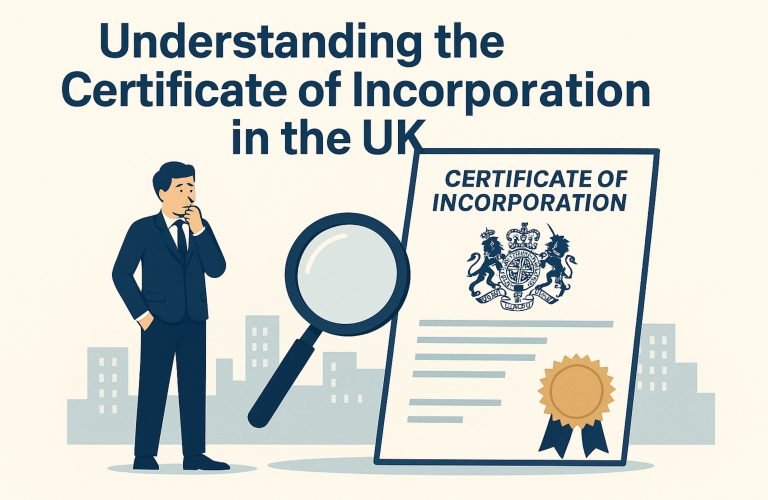
If you’ve recently registered a company in the UK, one of the most important documents you’ll receive is the Certificate of Incorporation. But what exactly is it—and why does it matter?This guide explains what the Certificate of Incorporation is, what information it includes, why it’s important for legal and financial purposes, and how Dragonfly Associates can support your business—subject to agreement.

What Is a Certificate of Incorporation?

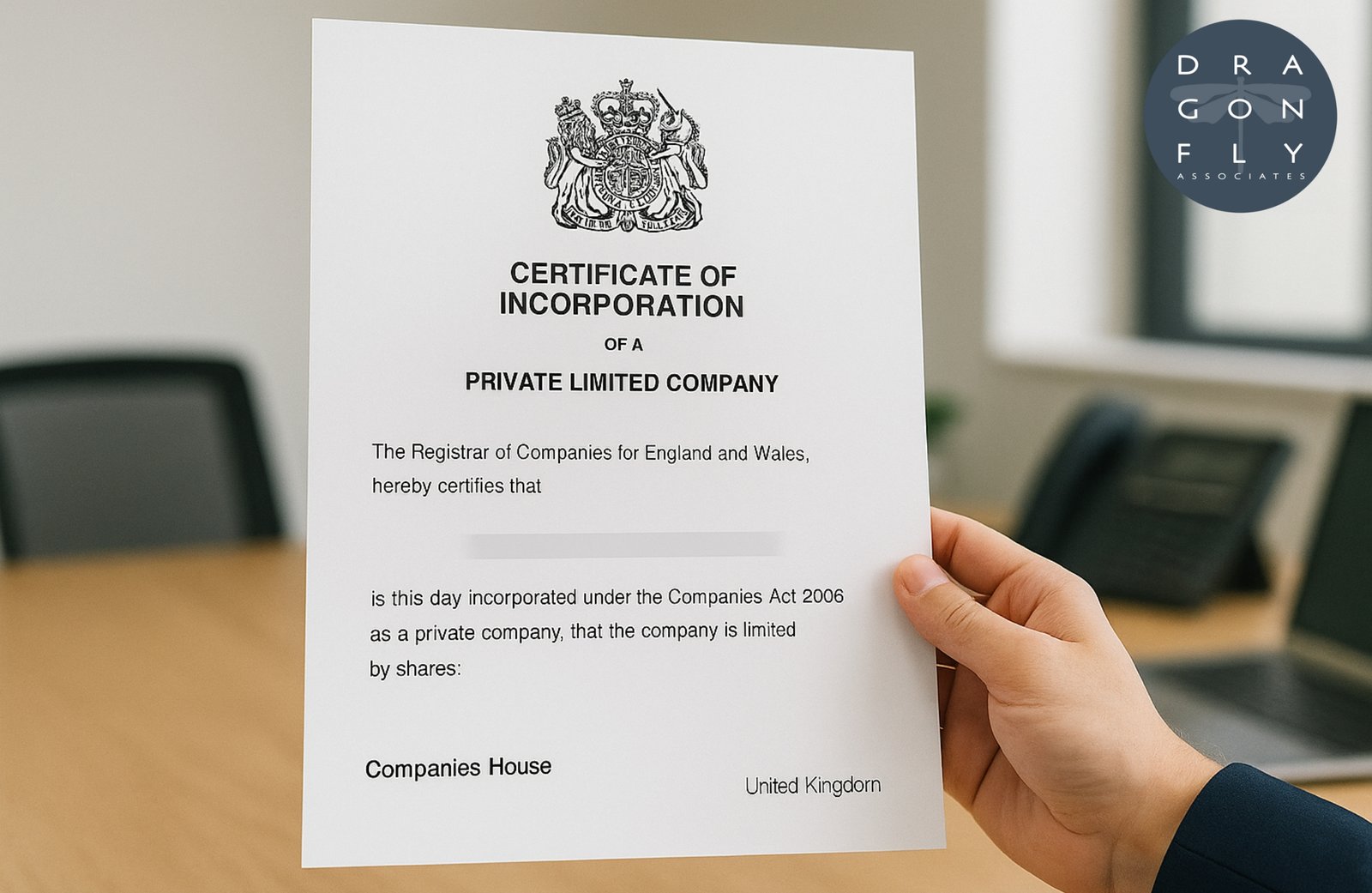
The Certificate of Incorporation is an official document issued by Companies House upon successful registration of a company in the UK. It acts as your company’s “birth certificate.”

It confirms that:

  • The company has been legally formed under the Companies Act 2006
  • The business exists as a separate legal entity
  • The company name, number, and date of incorporation are officially recognised

What Information Does It Include?

Your certificate will include several key details, such as:

  • Company name
  • Company number (CRN)
  • Date of incorporation
  • Jurisdiction (e.g., England & Wales, Scotland, or Northern Ireland)
  • Companies House registrar’s authentication


Why Is the Certificate of Incorporation Important?

Why Is It Important?

The Certificate of Incorporation is essential for proving your company’s existence. It’s often needed to:

  • Open a business bank account
  • Apply for funding or grants
  • Sign leases or contracts
  • Register for VAT or PAYE
  • Provide assurance to clients and suppliers

Digital and Paper Versions

Companies House issues digital certificates for online incorporations, but you can also request a printed version. Both are equally valid legally.

Lost Your Certificate?

If you’ve lost your certificate, don’t worry. You can:

  • Download a copy from Companies House (if registered online)
  • Request a replacement via post
  • Ask your formation agent for assistance (if you used one)

Dragonfly Associates can assist you with retrieving official documents and ongoing compliance matters—subject to agreement.

How Dragonfly Associates Can Help

We provide support for:

  • Company formation
  • Compliance filing
  • Certificate retrieval and documentation
  • Registered office and service address provision

Whether you’re a UK-based entrepreneur or an overseas director, we ensure all your company documents are in order and accessible when you need them.

Frequently Asked Questions

Is the Certificate of Incorporation proof of ownership?

No. It proves formation, not ownership. Shareholder records provide ownership information.

Do I need the certificate to trade?

While you can trade without showing it, many third parties (banks, landlords, etc.) require it as proof your company exists.

Does it expire?

No. The certificate is valid indefinitely unless the company is dissolved.

Final Thoughts

The Certificate of Incorporation is a critical document in your business journey. Keep it safe and accessible. If you ever need help managing or replacing your certificate—or ensuring your company stays compliant—Dragonfly Associates is here to assist, subject to agreement.

Last Updated: September 19, 2025
The UK is a popular destination for international business owners—and you don’t need to live in the UK to be a director of a UK company. But there are important legal, tax, and operational considerations to be aware of.This article explains whether a non-resident can be a UK company director, what’s required by law, and how Dragonfly Associates supports international clients with compliant company formation and administration—subject to agreement.

Can a Non-Resident Be a Director of a UK Company?

Yes. There is no legal requirement for a UK company director to be a UK resident. A non-resident can:

  • Act as a sole director (if over 16 and not disqualified)
  • Own shares in the company
  • Manage the company from abroad

However, you must still meet all compliance requirements under UK law and be able to receive official correspondence reliably.

Legal and Administrative Requirements

To act as a director, you must:

  • Provide a valid service address (can be in the UK or overseas)
  • Submit your personal details to Companies House (e.g. name, date of birth, nationality)
  • Comply with your director duties under the Companies Act 2006
  • Ensure your company has a registered office address in the UK

Dragonfly Associates offers UK-based registered office and service address support for non-resident directors, subject to agreement.


Registered Office Requirement

Registered Office Requirement

While directors can reside anywhere in the world, the company’s registered office must be located in the UK (and in the jurisdiction of incorporation: England & Wales, Scotland, or Northern Ireland).

This is where official government correspondence will be sent. We provide this service to clients as part of our compliance and virtual office packages.

Tax Considerations

Being a non-resident director does not automatically create UK tax obligations—but your company may be affected based on where management and control are exercised.

  • Corporation Tax: Your company will usually pay tax in the UK on its profits, regardless of where directors live
  • Permanent Establishment Risk: If major decisions are made abroad, it could raise questions about tax residency in another country
  • Double Tax Treaties: These help avoid being taxed twice on the same income

We recommend seeking international tax advice. We work with tax partners to guide non-resident directors through risk and compliance.

Banking and Financial Access

Opening a UK business bank account as a non-resident director can be more challenging. Some traditional banks require:

  • UK-based directors
  • In-person identity verification

However, digital banking options exist for non-resident companies, and Dragonfly Associates helps explore compliant solutions—subject to agreement.

Maintaining Control and Communication

As a non-resident director, it’s important to:

  • Use secure digital communication tools
  • Maintain clear internal records
  • Appoint a reliable UK address provider
  • Keep up with annual filings and deadlines

We act as a communication bridge between non-resident directors and UK authorities through our secretarial and compliance services.

Frequently Asked Questions

Do I need a visa or UK tax ID to be a director?

No. There is no requirement for UK residence or tax registration to serve as a director.

Can a company have only non-UK directors?

Yes. A UK company may have all directors based outside the UK, provided it maintains a UK registered office.

Can Dragonfly Associates help me run a UK company from abroad?

Yes. We support international directors with company formation, registered office, mail forwarding, and ongoing compliance—subject to agreement.

Lead a UK Company from Anywhere

You don’t need to live in the UK to take advantage of its business environment. With the right structure and support, non-resident directors can operate legally and efficiently.

Dragonfly Associates helps non-UK residents register, maintain, and grow their UK companies—with address services, filings, and regulatory support available through our international service packages.

To set up or manage your UK company from abroad, contact our team today.

Last Updated: September 19, 2025
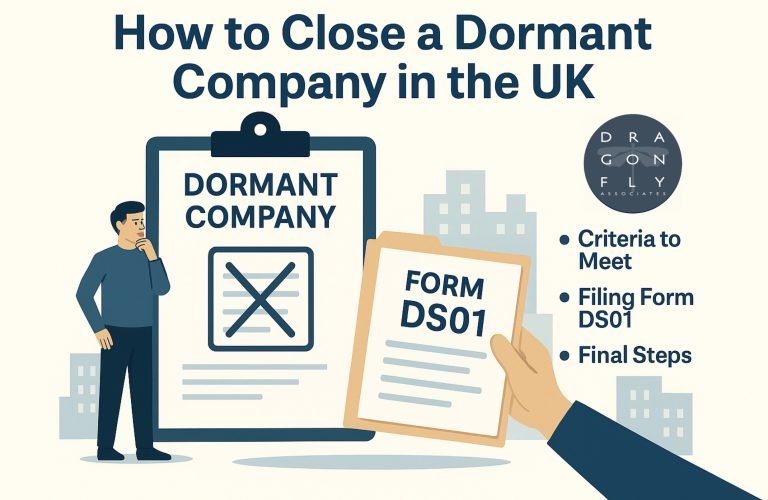
Even if your company is dormant (inactive and not trading), you can’t simply ignore it. If you no longer need your UK dormant company, it’s important to formally close it to avoid ongoing filing obligations or penalties.This guide explains how to close a dormant company properly, what steps are required, and how Dragonfly Associates helps clients complete the process—subject to agreement.

What Is a Dormant Company?

A dormant company is one that has no “significant accounting transactions” and is not actively trading. You may have kept the company dormant for brand protection, investment planning, or future use.

However, maintaining a dormant company still requires:

  • Annual accounts (simplified)
  • Confirmation Statements
  • Maintenance of statutory registers

If you no longer need it, dissolving the company can save time and cost.

How to Close a Dormant Company

Dormant companies are usually closed through a voluntary strike-off using form DS01. The process is straightforward if:

  • The company has not traded or changed names in the last 3 months
  • There are no outstanding debts, liabilities, or legal actions
  • Assets (if any) have been dealt with properly

Dragonfly Associates reviews your company’s eligibility for strike-off and prepares the necessary documentation.


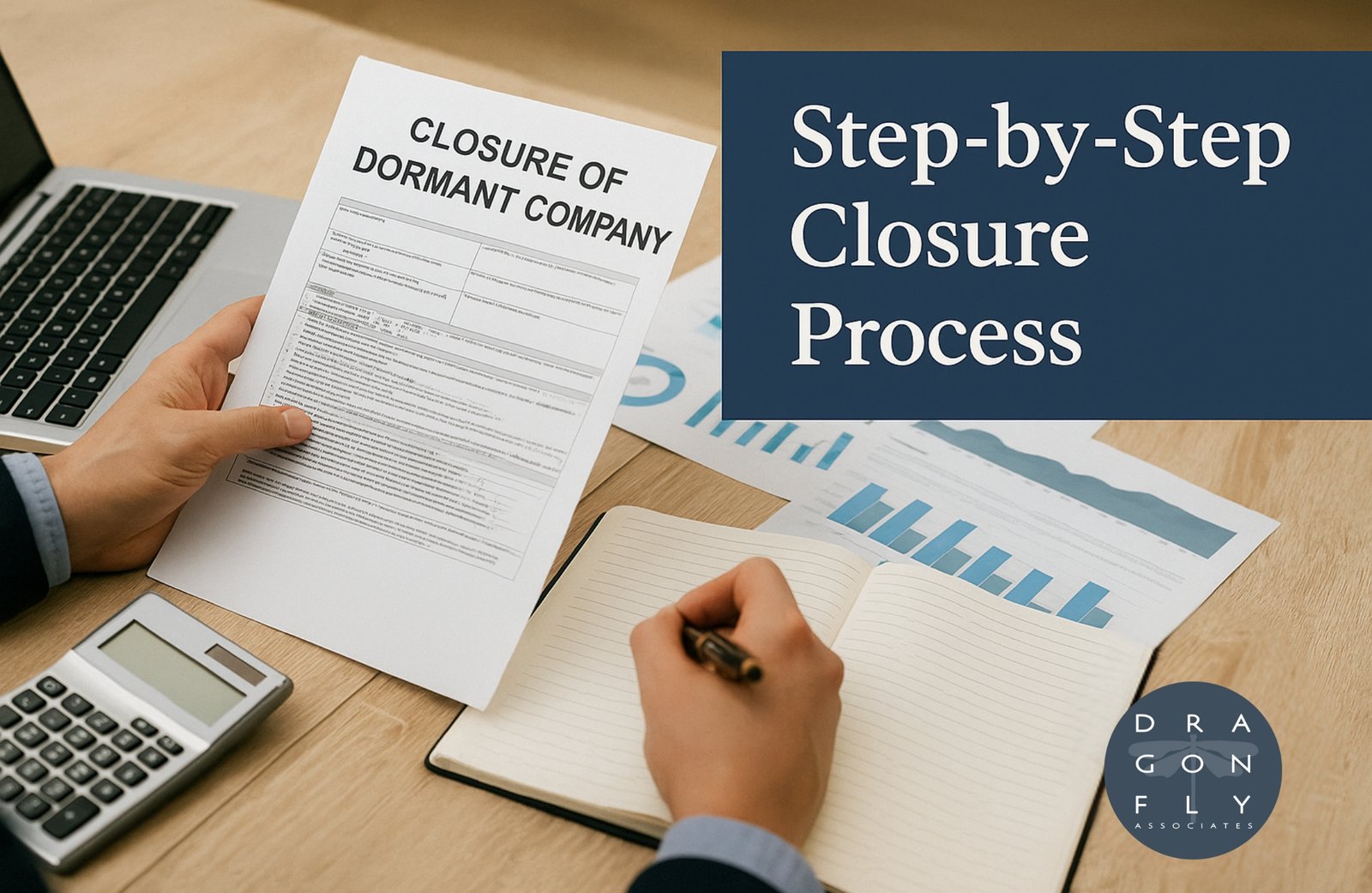
Step-by-Step Closure Process

Step-by-Step Closure Process

1. Board Approval

Pass a resolution confirming that the company is no longer needed and will apply for strike-off.

2. Prepare and Submit DS01

Form DS01 must be signed by a majority of directors and submitted to Companies House along with the appropriate fee (£10).

Once accepted, Companies House will publish a notice in The Gazette stating the intention to strike the company off.

3. Wait for Objections

If no objections are received within 2 months, the company will be formally dissolved and removed from the register.

We monitor this timeline and manage all communication with Companies House.

Settling Any Remaining Obligations

Before submitting DS01, make sure:

  • Final dormant accounts are filed (if required)
  • Confirmation Statement is up to date
  • HMRC is informed of your intent to dissolve
  • Business bank accounts are closed
  • Any remaining company assets are distributed

Failing to do so may lead to rejection of the application or future complications. We help ensure all loose ends are tied up.

Avoiding Future Costs or Penalties

Leaving a dormant company open can lead to:

  • Automatic penalties for missed filings
  • Strike-off by Companies House without warning
  • Potential director disqualification for repeated non-compliance

We help you close your dormant company cleanly and without risk.

Frequently Asked Questions

Do I have to file accounts before closing a dormant company?

Yes, you must file any due accounts and make sure the company is fully compliant before applying for strike-off.

Can I reopen a company after it’s closed?

No. Once dissolved, the company no longer exists. Restoration is possible, but it requires a formal application and justification.

Can Dragonfly Associates help with this?

Yes. We assist with DS01 preparation, compliance checks, and all closure filings under defined support packages—subject to agreement.

Close Your Dormant Company the Right Way

Closing a dormant company is simple—but only if the process is handled correctly. With proper filings and communication, you can dissolve your company and move forward without risk.

Dragonfly Associates provides full support for dormant company closure, including final checks, filings, and liaison with Companies House—delivered under service agreement.

Contact our team today to begin your company’s closure with confidence.

Last Updated: September 19, 2025
Whether you’re repositioning your brand, bringing on new partners, or simply outgrowing your original name, changing your company’s name is a strategic move that must be done properly.This article explains how to legally change your company name in the UK, what branding factors to consider, and how Dragonfly Associates supports you throughout the process—subject to agreement.

Why Change a Company Name?

  • Rebranding or repositioning the business
  • Reflecting new ownership or partnerships
  • Expanding into new markets or sectors
  • Avoiding confusion with other companies
  • Legal requirements or trademark conflicts

Dragonfly Associates helps assess the naming impact on your identity, clients, and compliance obligations.

Legal Requirements for Name Change

The Companies Act 2006 outlines how UK limited companies can change their name. The process involves:

  • Checking that your desired name is available
  • Passing the required resolutions
  • Submitting the correct form to Companies House
  • Updating all official records and communications

We guide you through each step to ensure your change is accepted without delays.


Step-by-Step - How to Change a UK Company Name

Step-by-Step: How to Change a UK Company Name

1. Choose a New Name

Make sure it:

  • Is not already in use by another UK company
  • Doesn’t infringe trademarks
  • Meets Companies House naming rules

We assist with name searches and compliance checks.

2. Obtain Approval

You’ll need:

  • A special resolution passed by shareholders
  • Board minutes or written resolution confirming the change

If your Articles allow directors to decide, shareholder consent may not be required. We draft the correct resolution for your structure.

3. File Form NM01

Submit form NM01 (Notice of Change of Name) to Companies House with the resolution and filing fee (£8 online / £10 by post).

Once approved, Companies House will issue a Certificate of Incorporation on Change of Name, which becomes your new legal identity.

4. Update Your Records

  • Update stationery, website, emails, and marketing
  • Notify HMRC, banks, clients, and suppliers
  • Update contracts and business documents
  • Update domain registrations and social media

We provide a post-change checklist and support communication rollouts where agreed.

Impact on Branding and Operations

Changing your name can be a powerful brand refresh—but it must be handled with care to avoid confusion or disruption.

  • Secure matching domain names and trademarks
  • Prepare public announcements and transition plans
  • Ensure continuity of customer trust and legal contracts

Frequently Asked Questions

Will my company number change?

No. The company number remains the same—only the name changes.

Can I use a trading name instead?

Yes, but your legal name must still appear on invoices and formal documents.

Can Dragonfly Associates help?

Yes. We prepare and file NM01, resolutions, and notify stakeholders under our company secretarial services—subject to agreement.

Rename Your Business with Confidence

Changing your company name is more than a form—it’s a chance to redefine your brand. With the right planning and documentation, it’s a smooth transition that supports your future growth.

Dragonfly Associates helps you plan, document, and file your name change, including Companies House notifications and branding guidance—available under clearly defined service plans.

Contact our team today to discuss your company name change.

Last Updated: September 19, 2025
Whether you’re rewarding a co-founder, bringing in an investor, or raising capital, issuing shares is a fundamental part of running a UK limited company. But it’s not as simple as handing out equity—you need to follow a legal process and consider the strategic implications.This article outlines how to issue shares legally, what documents are required, and how Dragonfly Associates supports clients during this process, subject to agreement.

What Does It Mean to Issue Shares?

Issuing shares means creating and allocating new shares to individuals or entities. This is different from transferring existing shares between shareholders—it increases the total number of shares in the company.

Common reasons to issue new shares include:

  • Onboarding a co-founder or advisor
  • Raising funds from an investor
  • Employee incentive schemes (e.g. EMI options)
  • Business growth or capital restructuring

Step-by-Step - How to Issue Shares

Step-by-Step: How to Issue Shares

1. Check the Articles of Association

Ensure your Articles allow share issuance and whether you need shareholder or board approval. If the Articles restrict it, you may need a special resolution to amend them.

2. Determine the Share Class and Rights

Decide what type of shares to issue:

  • Ordinary shares (equal voting, dividends, and capital)
  • Preference shares (fixed dividends, priority return)
  • Non-voting or alphabet shares (for internal structuring)

We advise clients on share classes and their implications for control and dilution.

3. Pass a Board Resolution

The board must formally approve the issuance by passing a resolution. This authorises the allocation, sets the share price, and designates the recipient.

4. Complete the Share Allotment (Form SH01)

File form SH01 with Companies House within one month of issuing shares. This includes:

  • Company details and share class
  • Number of shares allotted
  • Nominal value and amount paid
  • Date of allotment

Dragonfly Associates prepares and submits this form as part of our compliance support.

5. Issue Share Certificates and Update Registers

After issuance:

  • Issue a share certificate to the new shareholder
  • Update the Register of Members
  • Log details in the Register of Allotments

We manage all register updates and documents on your behalf.

6. Reflect Changes in the Next Confirmation Statement

Although Companies House receives SH01, changes in shareholding must still be reflected in your next Confirmation Statement (CS01). We ensure full consistency across filings.

Strategic Considerations

Issuing shares may affect:

  • Control and voting rights
  • Share dilution for existing members
  • Valuation and investor expectations
  • Future fundraising or exits

We help clients weigh up legal and strategic outcomes before finalising share issues.

Frequently Asked Questions

Can I issue shares to myself?

Yes, if you’re the sole director/shareholder and your Articles allow it. Still, formal board minutes and filings are required.

Is there tax when issuing shares?

Issuing new shares is not subject to stamp duty, but other tax implications (like income tax on under-market-value shares) may apply.

Can Dragonfly Associates manage the whole process?

Yes. We draft board resolutions, prepare SH01, issue certificates, update registers, and advise on structure—all subject to agreement.

Issue Shares with Confidence

Issuing shares is a powerful tool to grow your business—but it must be handled with care. A proper legal process avoids future disputes, protects your company’s structure, and strengthens investor confidence.

Dragonfly Associates offers full-service share issuance support—from board documentation to Companies House filings—via structured compliance packages.

To start issuing shares the right way, contact our team today.

© All rights reserved. Made with love by Ottmann-Polignac

4tehrwq

Congratulations! This company name is available.

4tehrwq

Unfortunately, this name is not available for registration.
Please select another.